

If you sell through distributors, you already know the frustrating pattern:
You roll out a sales enablement platform. Marketing uploads the “latest” assets. Training runs a webinar. Everyone nods.
Then field reality hits. Distributor reps keep using whatever is fastest: old PDFs, screenshots, email threads, and a folder called “NEW FINAL v7.”
Adoption is not a motivation problem. It is a workflow problem.
Distributor reps will use your platform when it helps them do one thing better than their current habits: move a deal forward in the moment.
This article breaks down why distributors ignore enablement tools, what actually changes behavior, and how to design an enablement motion that fits the way distributor reps sell (fast, mobile, in the field, often offline).
What is sales enablement for distributors?
Sales enablement for distributors is the practice of equipping channel reps — distributor, wholesaler, and independent reps who don't work for you — with current approved content, product training, and fast answers, delivered the way they actually sell: mobile, in the field, and often offline.
It is a different problem from enabling a direct team, for three structural reasons:
- Your line is one of many. A distributor rep may carry five manufacturers' products. Your content competes for attention with everyone else's.
- They live outside your systems. No company laptop, no seat in your CRM, no obligation to attend your all-hands. Whatever you give them has to stand on its own — which is why sales enablement for distributor networks is built around role-based access rather than employee onboarding.
- Their loyalty follows speed. The manufacturer whose materials are easiest to find, trust, and share is the one whose products get pitched first.
Everything below follows from those three facts.
Why distributors don’t use your platform (even when they like it)
Most distributor enablement fails for predictable reasons:
1) Your platform is not the fastest path to “the thing I need right now”
Distributor reps do not wake up thinking, “I should use the manufacturer’s enablement portal.”
They wake up thinking:
- “I have a case at 10:30. I need the sizing chart.”
- “Value analysis just asked for IFU and sterilization method.”
- “Surgeon wants a 30-second comparison slide.”
If the fastest way is texting a buddy, they will text a buddy.
In practice: adoption improves when reps can search once on mobile, find the approved asset instantly, and share it by text or email in a branded format without switching apps. This highlights the importance of having a mobile sales enablement solution that allows for quick access to necessary information.
The same speed test applies anywhere reps sell face to face — it is why a sales enablement solution at trade shows lives or dies on the same two-tap standard.
2) Reps can’t trust what’s current
Distributors sell multiple lines. They do not have time to guess which PDF is the latest approved version.
If they get burned once, they stop trying.
In practice: a single content library with automatic syncing removes “version anxiety” and makes “use the platform” feel safe. For example, medical device manufacturers can keep distributor sales reps equipped with the right content by ensuring they have access to current, approved, auditable content—without slowing down deals.
3) They are often in low-connectivity environments
Hospitals, basements, OR corridors, rural clinics, and elevators are not friendly to web portals.
If “enablement” needs perfect Wi‑Fi, it is not enablement.
In practice: content that works without Wi-Fi — saved to the device, accessible instantly — makes the platform usable where selling actually happens.
4) Your rollout assumes they work like your direct reps
Distributor reps are not employees. They do not attend all-hands. They do not live in your CRM. They are not measured on your internal KPIs.
They will not “check the portal weekly.”
They will use what helps them win.
In practice: make enablement fit into their existing rhythm: mobile-first access, fast sharing, and minimal clicks between question and answer. Meeting reps where they already work — not asking them to change — is what separates adopted platforms from ignored ones.
5) The platform feels like “marketing homework”
If the first experience is a library of 600 files, reps will bounce.
Distributors do not need more content. They need the right content surfaced at the right time.
In practice: AI-driven discovery that understands your PDFs, videos, and training content can return the right asset in seconds, even when the rep searches in messy real-world language. This aligns with some of the key statistics about sales enablement that show its impact on improving sales performance.
The adoption rule: distributor reps adopt tools that compress time
Here is the simplest way to think about adoption:
If your platform reduces time-to-answer and time-to-share, usage goes up.
If it increases steps, logins, and uncertainty, usage goes down.
So the strategy is not “train harder.” The strategy is “remove friction.”
Start with the real jobs-to-be-done (not your content categories)
Stop organizing enablement around internal departments like “Marketing,” “Clinical,” and “Training.”
Organize it around field moments.
Here are the moments that drive distributor behavior in medical device and life sciences:
Moment A: “I need an answer before I walk into the room”
Example: A distributor rep is outside a procedure room. A surgeon asks, “What’s the MRI conditional status again?”
They cannot dig through folders. They need a fast, confident answer.
What to build:
- A short “field answers” experience that pulls from approved source material
- The ability to search in plain language
- Offline access for the top questions
In practice: reps type a question, get an approved answer grounded in your actual PDFs and training, and can immediately send the supporting doc as a follow-up.
Moment B: “Send me that right now”
Example: Value analysis asks for the UDI, latex status, reprocessing info, or a one-page clinical summary.
If the rep cannot deliver within minutes, the buyer moves on or pings a competitor.
What to build:
- One-tap share from mobile (text/email)
- Branded, controlled sharing so the buyer gets a clean experience
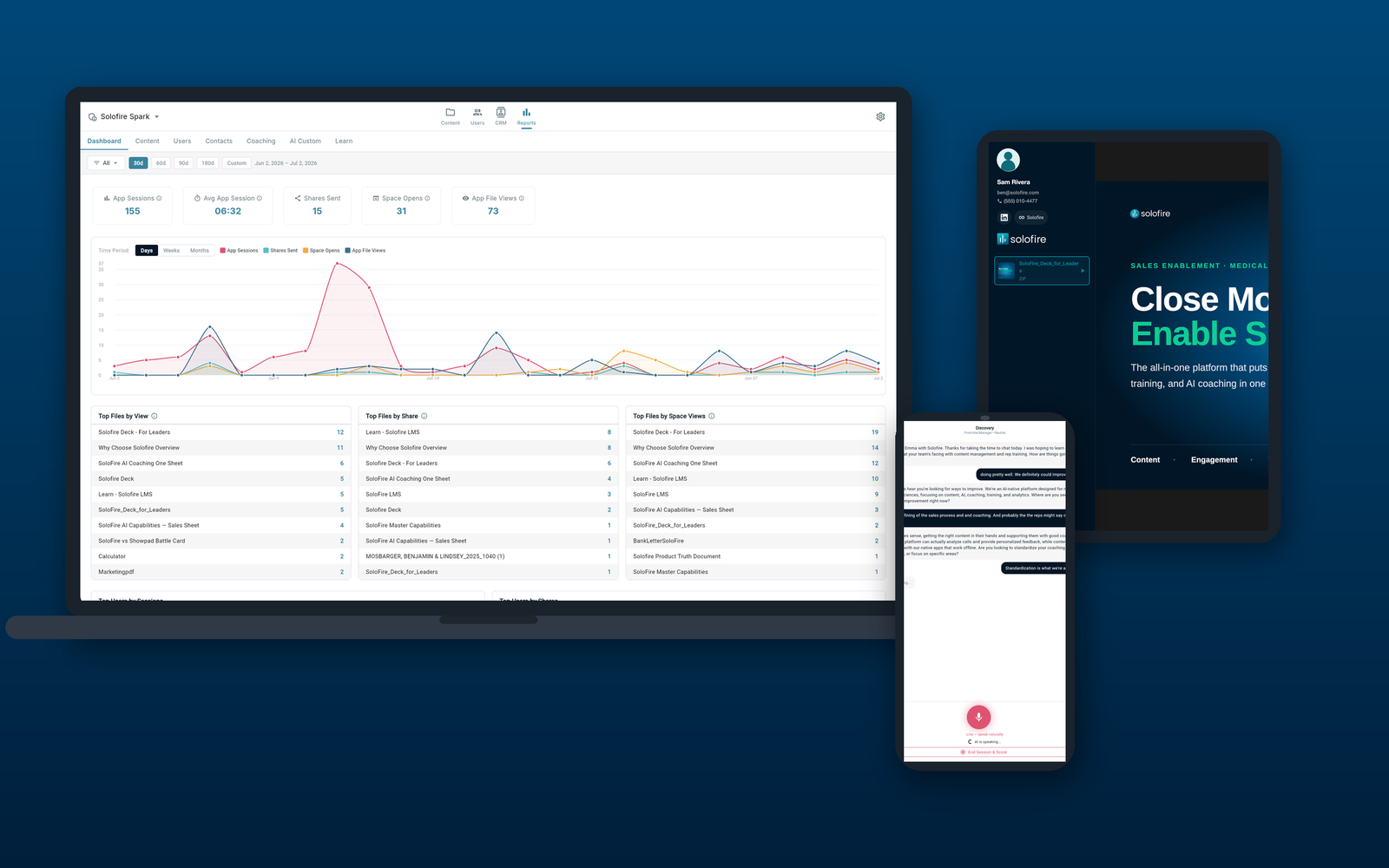
- Visibility into what was viewed
In practice: the rep shares a branded link or space, sees that the committee opened it, and knows which page they spent time on before the next call.
To facilitate these moments effectively, it’s essential to leverage tools that sales need, which can significantly enhance productivity and streamline processes.
Moment C: “Make this specific to my account”
Example: A rep needs a custom presentation for a surgeon group with three relevant slides, not a 40-slide deck.
What to build:
- Lightweight presentation building
- Only approved slides and media
- Fast assembly on mobile (or at least without PowerPoint gymnastics)
In practice: the rep creates a short custom deck from approved modules in the app, shares it immediately, and tracking shows which slides got engagement.
Moment D: “I need to prove this is working”
Example: Your channel manager asks, “Are distributors using the new launch assets? Are they converting?”
If you cannot see usage, you cannot improve it.
What to build:
- Real-time usage analytics
- Shares, views, time spent, and downstream impact
- A simple dashboard that shows adoption without manual chasing
In practice: marketing and training teams see which assets are used in live deals, then retire what is not working and double down on what is.
Fix friction first: the five adoption levers that matter
1) Make mobile the primary experience
Distributor reps live on their phone. If the platform is “desktop-first,” adoption is capped.
Mobile-first means:
- Search is prominent
- Content loads instantly
- Sharing is native (text/email)
- Offline is built-in, not a workaround
Concrete example: a rep pulls up an IFU on their phone in a hospital corridor, even with spotty service, and forwards it to a nurse manager before the meeting ends.
In practice: reps open the app, search once, save key assets offline, then share approved materials in seconds without hunting through email.
2) Reduce “time-to-approved” for every asset
Distributors will always find content. The question is whether they find the approved version.
You need:
- Automatic content syncing so updates propagate everywhere
- Clear “approved” signals
- Governance that does not slow field access
Concrete example: a legacy brochure is replaced after a labeling update. The rep should not be able to accidentally send the outdated PDF next week.
In practice: when stakeholders update a file, every rep sees the new version immediately, including offline packages that refresh automatically.
3) Build sharing that matches how distributors actually share
Distributors share in the fastest channel available: text, email, and sometimes WhatsApp.
Your platform should support:
- One-tap share via text/email from mobile
- Fully branded buyer experience
- Controlled formats (so nothing gets copied into random Dropbox links)
Concrete example: a rep texts a surgeon a two-slide overview and a clinical summary right after a case, without opening three different apps.
In practice: sharing happens from inside the enablement workflow, and engagement tracking shows what the surgeon actually opened.
4) Use insights to coach, not to police
If analytics feels like surveillance, distributors will avoid the tool.
Position tracking as:
- “What helps win deals”
- “What is resonating”
- “What to use next”
Not:
- “We are watching you”
Concrete example: you notice distributors are sharing the same objection-handling sheet repeatedly in late-stage deals. That is a signal to invest in that content and train around it.
In practice: dashboards show usage, shares, and engagement by asset and region, then teams iterate based on deal reality.
5) Make discovery smarter than folders
Folders are an internal mental model. Field reps think in questions and situations.
The strongest adoption boost often comes from replacing browsing with:
- Search that understands product language and synonyms
- AI Q&A trained on your actual content (not generic internet answers)
- Suggested assets based on the question or persona
Concrete example: a rep searches “latex” and immediately gets the approved latex statement, the labeling page, and the one-pager for materials and compliance.
In practice: AI surfaces the right content instantly, and the rep can share the supporting PDF right from the answer.
Align incentives without turning this into a compliance project
You cannot “mandate” distributor behavior. But you can align incentives so the platform becomes the easiest path to revenue.
Here are practical plays that work:
Play 1: Launch kits that are truly field-ready
Instead of dumping 50 assets, publish:
- 3 must-use pieces (one-pager, objections, clinical proof)
- 1 fast custom deck template
- 1 “answers” module for common questions
Then measure adoption and iterate weekly for the first month.
In practice: reps see a small set of offline-ready content for the launch, share it immediately, and you track which pieces are used in live conversations.
Play 2: Tie platform usage to faster support
Distributors care about responsiveness.
You can create a simple rule:
- “If you share via the platform, we can see what the customer viewed and help you follow up faster.”
This is not punishment. It is leverage.
In practice: when a rep shares a branded space, internal teams see engagement and can recommend the next asset, plus log activity back to CRM if needed.
Play 3: Build a “field wins” loop
Every month, highlight:
- Top-used assets
- A distributor story where speed helped close
- One improvement shipped based on rep feedback
Make it clear the platform is evolving around the field, not around headquarters.
In practice: usage insights identify the assets that actually move deals, and those become the default recommendations in the app.
Your enablement platform should act like a selling assistant
Distributors do not want a library.
They want an assistant that helps them:
- answer faster
- share faster
- follow up smarter
That is the bar.
This is where AI can be practical, not hype. An AI layer trained on your real materials (PDFs, videos, trainings) can give reps instant answers that stay consistent with your claims, positioning, and regulatory boundaries.
For instance, with a robust sales enablement app, reps could ask a question like, “What’s the cleaning protocol difference between Model A and B?” and get an answer grounded in your IFU, plus the exact pages to share with the buyer.
In practice: reps get a trusted answer, then attach the approved source document immediately, and you track what the buyer viewed.
What This Looks Like in Practice
Teams using SoloFire (formerly verbTEAMS) tend to drive adoption by focusing on outcomes that matter to distributor reps: instant access on mobile, offline-ready content in hospitals, fast sharing of approved materials, and visibility into what buyers engage with. The platform becomes less of a “portal” and more of a field tool reps keep open during real conversations.
In day-to-day use, that looks like a distributor rep pulling up an approved comparison in the parking lot, sending a branded set of assets by text before they enter the clinic, and the manufacturer seeing in real time what was opened, for how long, and what content is showing up in deals. The win is speed and clarity, not another content repository.
These results are achievable when teams leverage effective sales enablement strategies which include providing instant access to mobile-friendly content, ensuring offline-ready material for hospitals and facilitating fast sharing of approved resources.
A simple adoption checklist (use this before you blame “training”)
If distributors are not using your platform, run this checklist:
- Can a rep find the right asset in under 10 seconds on mobile?
- Can they access key content offline in a hospital?
- Can they share via text/email in two taps, fully branded?
- Are they confident the content is current and approved?
- Can they get quick answers grounded in your source material?
- Can you see usage, sharing, and buyer engagement without manual reporting?
- Are you using insights to improve content, not just to measure it?
If you cannot answer “yes” to most of these, adoption will remain spotty.
In practice: fix the two biggest friction points first (usually mobile search and offline access), then layer in sharing and engagement tracking so reps feel the platform making their day easier.
The real takeaway
Distributor adoption does not come from more content, more webinars, or more pressure.
It comes from helping reps move deals faster in real time.
When your sales enablement platform is offline-ready, mobile-first, and built for in-the-moment sharing, distributors use it because it works. When it is just another portal, they ignore it because they cannot afford the friction.
Build for speed. Build for simplicity. Build for the field.
And remember that adoption also depends on the people behind the tool. A platform nobody answers for becomes a platform nobody uses, which is why we put together the support questions to ask before you sign.
Adoption is also easier to fix when you know where your reps stand today — what sales readiness looks like and how to measure it is its own discipline, and it applies to channel reps as much as direct ones.
Does the same playbook work for wholesalers and channel partners?
Yes — wholesaler sales enablement and channel sales enablement fail and succeed for exactly the same reasons. A wholesaler rep also carries competing lines, also works outside your systems, and also adopts only what makes their day faster.
Two additions matter at wholesale and channel scale:
- Branch- and territory-specific targeting. A national wholesaler's Midwest branch should see Midwest promotions, pricing, and contacts — not everything. Content that feels curated for the branch gets used; a firehose gets ignored.
- Role-based access. Inside sales, field reps, and branch managers need different slices of the library. Segmenting content by user group keeps each partner seeing only the lines and materials that apply to them — which is also what keeps legal comfortable arming a channel you don't employ.
If you enable distributors well, extending the same motion to wholesalers and other channel partners is configuration, not a new program.
FAQs (Frequently Asked Questions)
What sales enablement tool works for distributor and wholesaler sales teams?
The tools that work for distributor and wholesaler teams are mobile-first, work offline, require near-zero onboarding, and make finding and sharing an approved asset faster than the rep’s current habits. Look for instant plain-language search, one-tap sharing by text or email, automatic content syncing so nothing outdated survives, and engagement analytics — without forcing channel reps into your internal CRM or KPI structure.
Which mobile sales tools do distributor reps actually use?
Distributor reps use whatever compresses time between a buyer’s question and an answer: their phone’s search, text messaging, and email. A sales enablement app earns a place in that rotation only when it is faster than those habits — approved content saved offline on the device, searchable in plain language, and shareable in two taps in a branded format.
Why do distributor reps often avoid using sales enablement platforms despite their availability?
Distributor reps avoid sales enablement platforms because these tools often don’t provide the fastest path to the information they need in the moment. They prefer quick access to specific assets like sizing charts or comparison slides and will resort to old habits such as texting colleagues if the platform slows them down. Adoption improves when platforms offer mobile-friendly, instant search and sharing capabilities without switching apps.
How can manufacturers ensure distributor reps trust the content in sales enablement platforms?
Trust is built by providing a single source of truth with automatic content syncing. Distributor reps sell multiple product lines and can’t afford to guess which version of a PDF is current. If they encounter outdated content once, they stop trying. Ensuring that the platform always has the latest approved versions removes ‘version anxiety’ and makes reps feel safe using it.
What challenges do distributor reps face with connectivity, and how should enablement platforms address this?
Distributor reps often work in low-connectivity environments such as hospitals, basements, OR corridors, rural clinics, and elevators where web portals struggle. Enablement platforms must be offline-ready by saving content directly to devices for instant access, ensuring usability exactly where selling happens without relying on perfect Wi-Fi.
Why is it important for sales enablement solutions to align with distributor reps’ work rhythms rather than internal direct rep processes?
Distributor reps are not employees; they don’t attend all-hands meetings, live in your CRM, or follow your internal KPIs. They won’t check portals regularly unless it helps them win. Therefore, enablement must fit into their existing rhythm—mobile-first access, fast sharing, minimal clicks—to be adopted effectively.
How does content overload impact distributor rep adoption of sales enablement tools and what is a better approach?
A large library of hundreds of files feels like ‘marketing homework’ and overwhelms distributor reps who need only the right content at the right time. AI-driven discovery that understands PDFs, videos, and training materials can surface relevant assets quickly—even when searches use messy real-world language—greatly improving adoption and effectiveness.
What is the key rule for increasing adoption of sales enablement platforms among distributor reps?
The key adoption rule is that distributor reps adopt tools that compress time-to-answer and time-to-share. Platforms that reduce steps, logins, and uncertainty increase usage. Conversely, adding friction lowers usage. The strategy should focus on removing barriers rather than just training harder.