
Sales enablement is the practice of giving sales reps the content, training, coaching, and data they need to have better conversations with buyers, and of measuring whether it worked. This guide defines it, breaks down the six parts that make it work, shows what it looks like in a real platform, and explains what changes when your reps sell in hospitals and labs.
The simplest sales enablement definition: everything an organization does to make its reps more effective in front of a buyer, delivered in a repeatable way rather than rep by rep. Marketing produces the content, sales leadership sets the process, training and product teams build the knowledge, and a platform puts all of it in one place the rep can reach from the field.
It is often confused with sales operations. The difference is the direction it faces. Sales operations looks inward at territories, quotas, forecasting, and the CRM. Sales enablement looks outward at the buyer conversation: what the rep says, shows, and leaves behind, and whether they were ready for it. Most companies need both, and the two share data. We cover the split in more depth in sales enablement vs. sales operations.
The stakes are measurable. Organizations with best-in-class enablement see roughly a 14% lift in quota attainment, while about 65% of marketing content goes unused because reps can't find it or don't trust it; the sourced evidence behind both numbers is collected in 16 sales enablement statistics.
Six factors make it work:
Marketing adds and updates content in one place; reps find it in seconds. Product sheets, videos, case studies, organized for a personalized buying journey.
Reps share approved content in a branded, trackable format and see who opened what and for how long, so follow-up is based on what the buyer actually did.
Continual, consistent development rather than one-and-done onboarding. Courses, videos, refreshers, and certifications that keep reps confident in every conversation.
Reps rehearse real buyer conversations, get scored against the playbook, and fix weak spots before they are in front of a customer. Managers see who is field-ready.
Give reps what they need to understand buyer intent, habits, and motives, so every conversation connects with the individual in front of them.
Dashboards show how buyers interact with content, which reps are active, and where the process leaks. Real-time numbers for marketing and sales, so everyone knows what's working.
Definitions are abstract. Here is what the six factors look like when they are running, using SoloFire's own screens.
Marketing publishes once. Every rep, distributor, and region sees the current version, organized by product line, and the retired version is gone everywhere at the same time. On a field-first platform the whole library is cached on the device, so it opens in a hospital basement with no signal.
How sales content management works →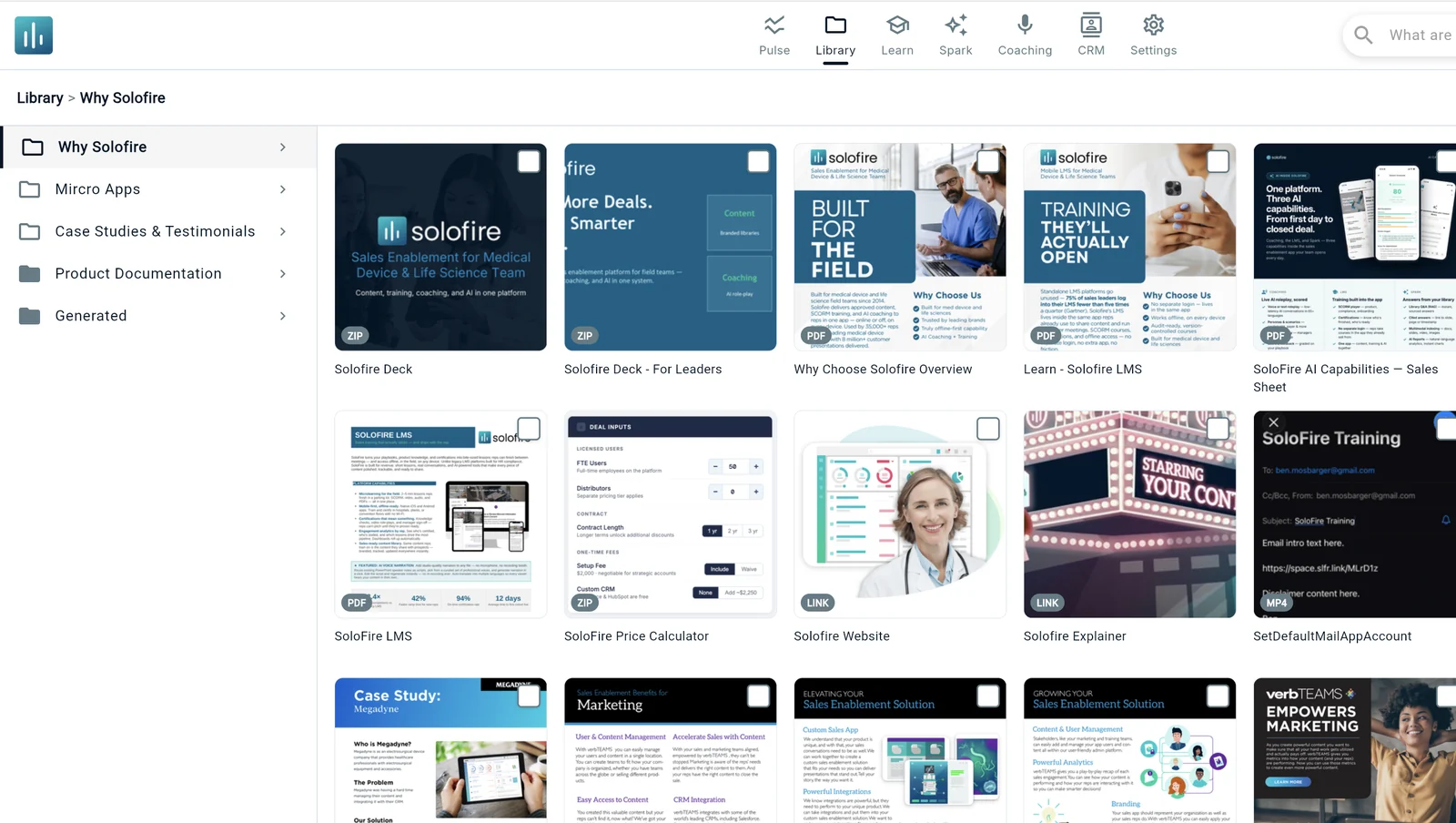
Instead of an email with four attachments, the rep sends a branded Space: a single link holding the deck, the clinical summary, and the pricing sheet. The rep sees who opened what and for how long, and every touch logs to the CRM without data entry.
See Spaces and buyer engagement →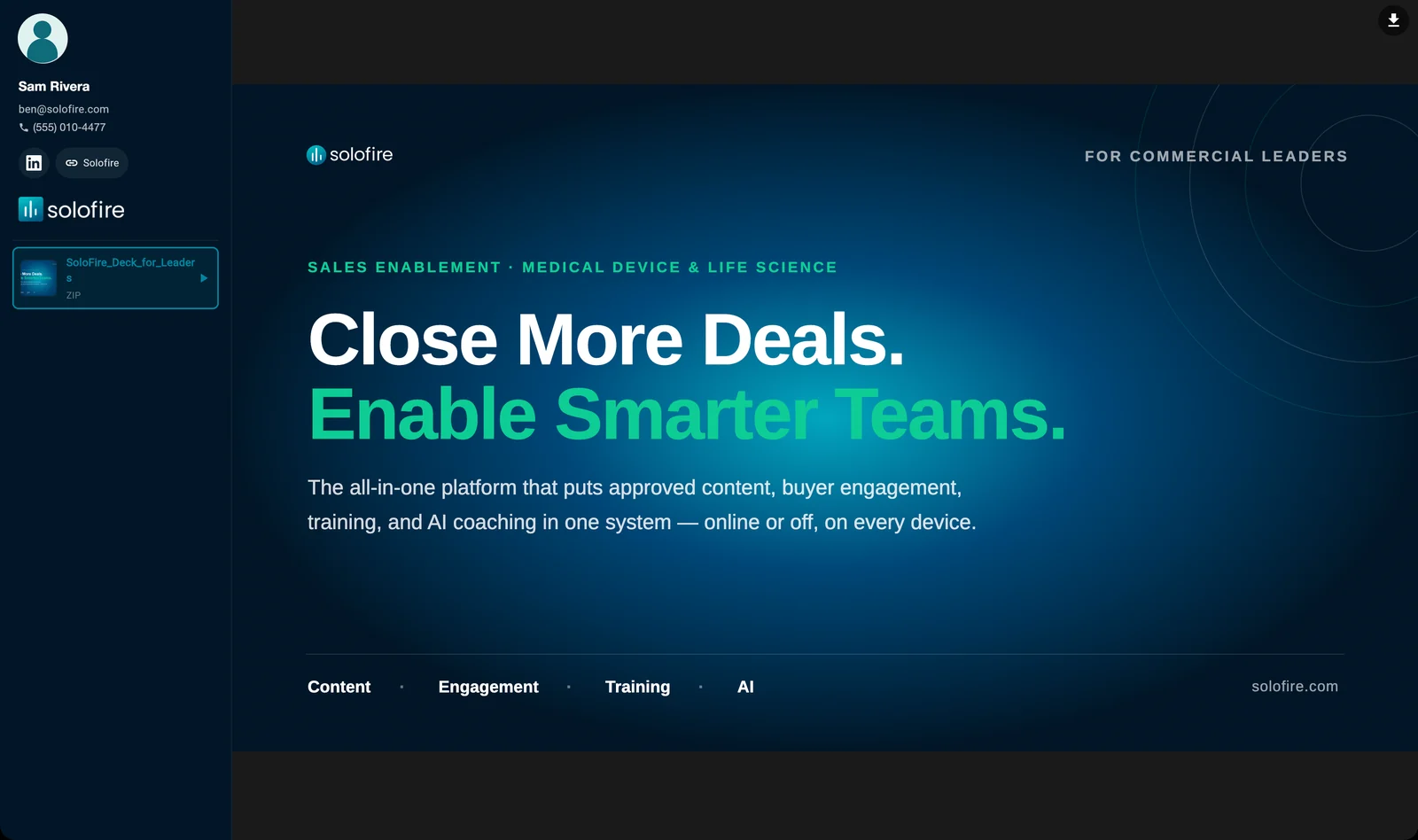
Onboarding paths, product certifications, and SCORM courses live next to the content reps use every day, so a new rep learns the product line in the same place they will sell it. Managers see completions and scores without exporting anything.
Explore the LMS and sales training →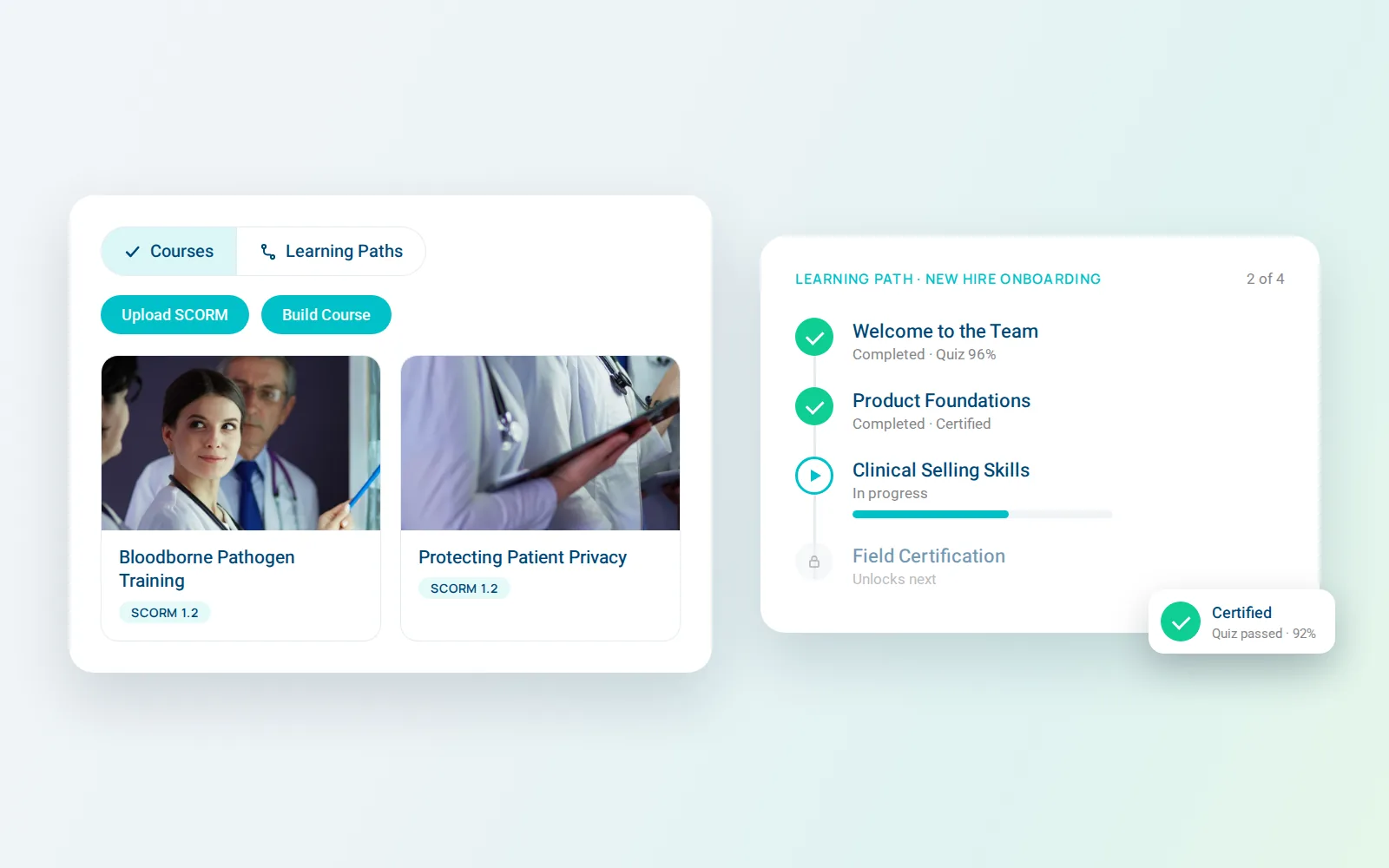
AI coaching gives every rep a realistic buyer to rehearse against: a skeptical surgeon, a price-focused materials manager, a value analysis committee. The conversation is scored against your playbook, and the manager sees who is ready for the field.
See AI sales coaching →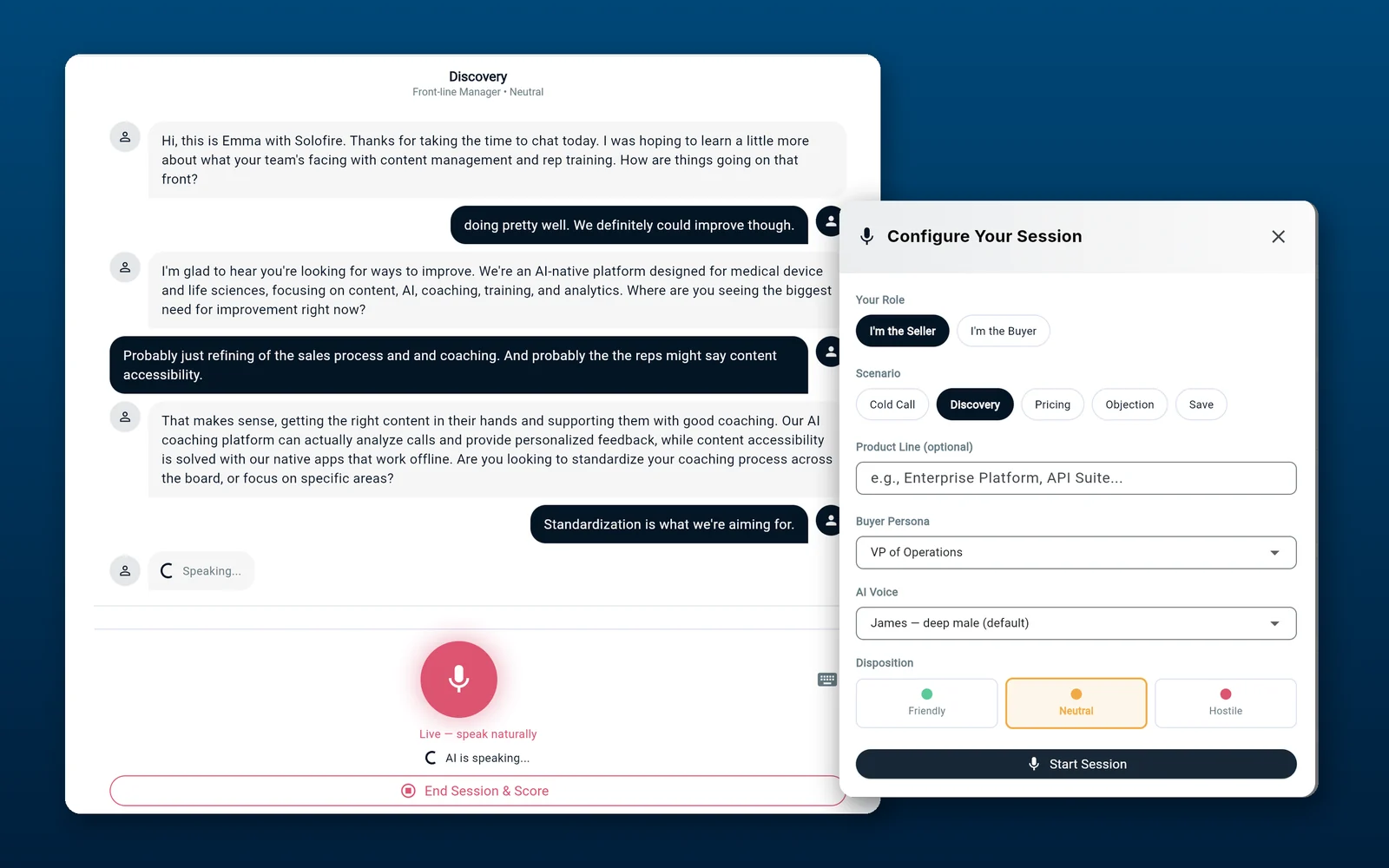
Reps ask a question in plain language ("what is the reimbursement code for this procedure?") and get an answer drawn only from approved content, with the source file attached. No searching folders, no guessing from memory.
How Spark AI works →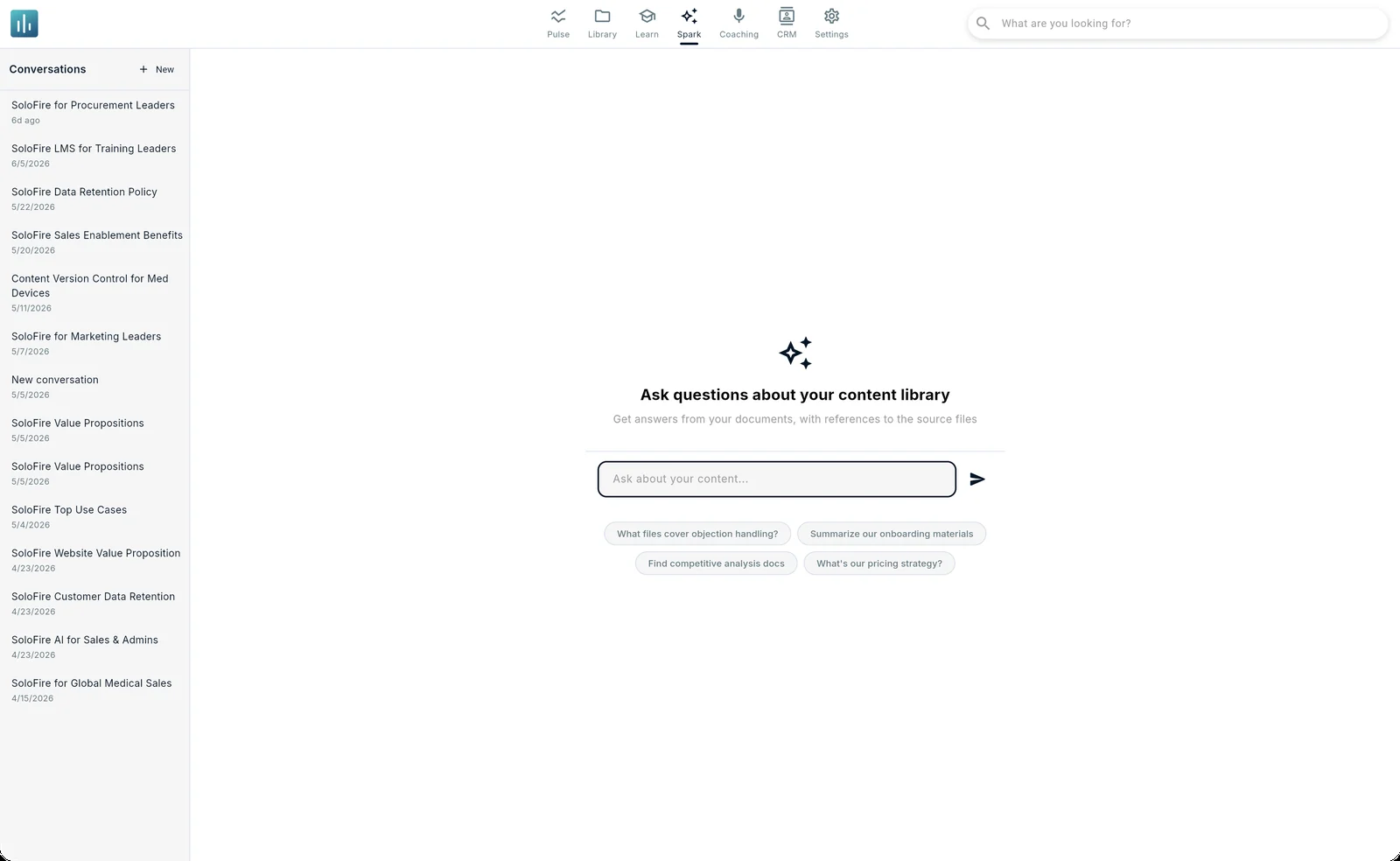
Marketing sees which assets are used and which are ignored. Sales leaders see rep activity, shares, and buyer engagement by account. The same dashboard answers "is this content working" and "is this rep working," which is the point of measuring enablement at all.
Reporting and CRM integrations →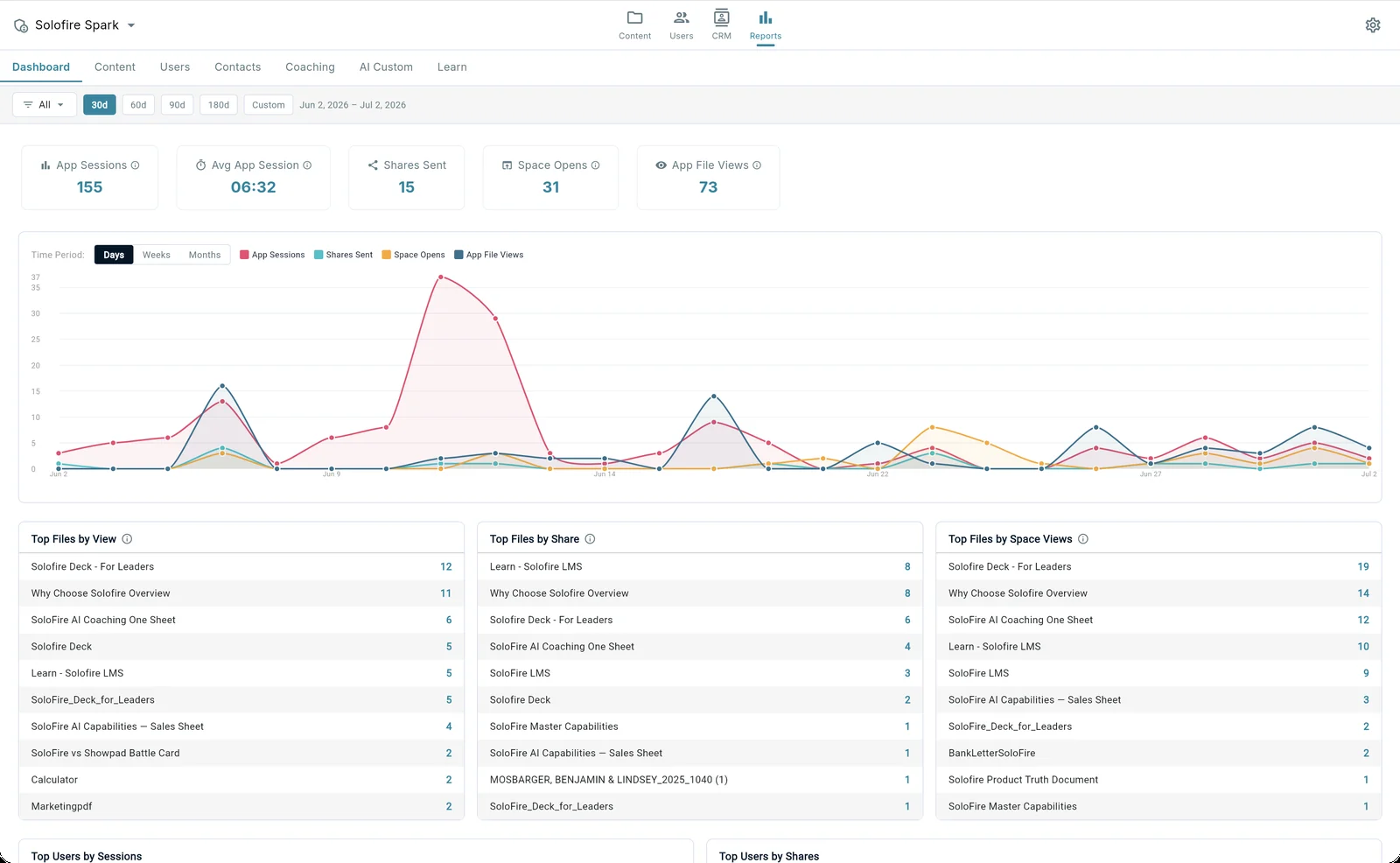
Done well, enablement shows up in three places at once: the rep's week, the buyer's experience, and the numbers leadership reviews. The full case, with the research behind each outcome, is on our guide to the benefits of sales enablement. To prove those outcomes to finance, see how to measure sales enablement.
See the Seven BenefitsOr declined, despite steady pipeline and effort.
Every rep tells a different story, with different materials.
Goals are set, but the team lacks the tools to reach them.
The funnel leaks and nobody can say exactly where.
You can't accurately track content usage, engagement, or rep activity.
Track four things: content usage by asset, buyer engagement per share, training completion and scores, and time to first deal for new reps. If a metric cannot change a decision about content, coaching, or hiring, drop it. Our guide to measuring sales ROI with enablement tools walks through the math.
Industry benchmarks for adoption, ramp time, and content waste are collected in 16 sales enablement statistics.
Generic sales enablement assumes a rep at a desk with Wi-Fi and content that anyone in marketing can edit. Neither is true for a rep walking into an OR. The stakes, and the requirements, are higher.
See how it applies to medical device sales enablement, where reps work offline in hospitals, sell through value analysis committees, and every asset has to be the approved version, and to life sciences sales enablement for pharma, biotech, and diagnostics teams whose content passes through MLR review before a rep can show it. Distributor networks add a third layer: enablement for independent reps who carry several manufacturers' lines.
See How SoloFire Does ItHospitals, ORs, and labs block or throttle outside devices. A platform that needs a signal to open a file is a platform reps stop carrying.
In medtech and pharma, an outdated claim in a rep's hands is a compliance event. Version control and forced retirement are core features, not extras.
The questions we hear most from marketing and commercial leaders evaluating enablement for the first time.