Highspot completed its merger with Seismic on August 18, 2026, so if you are evaluating or renewing Highspot right now, you are buying a platform mid-consolidation. Among Highspot alternatives, SoloFire is the one built for medical device and life science field teams: independent, offline-first for hospital selling, and priced on the page at $30 per user per month.
Highspot and Seismic — two of the three largest platforms in this category — completed their merger on August 18, 2026, with the combined company operating under the Seismic brand. Both platforms are said to continue being supported while product lines are unified. What that means for your roadmap in three years is a question worth asking in writing. SoloFire is independent: same team, same focus, same roadmap.
Hospitals are signal-hostile. SoloFire is offline-first by design — the full library, on native iOS, Android, Windows and Mac apps, with no connectivity required. Highspot's mobile app does support offline browse and search of content downloaded in advance. What it does not publish is where the limits are — and its own medical device page makes no offline claim at all.
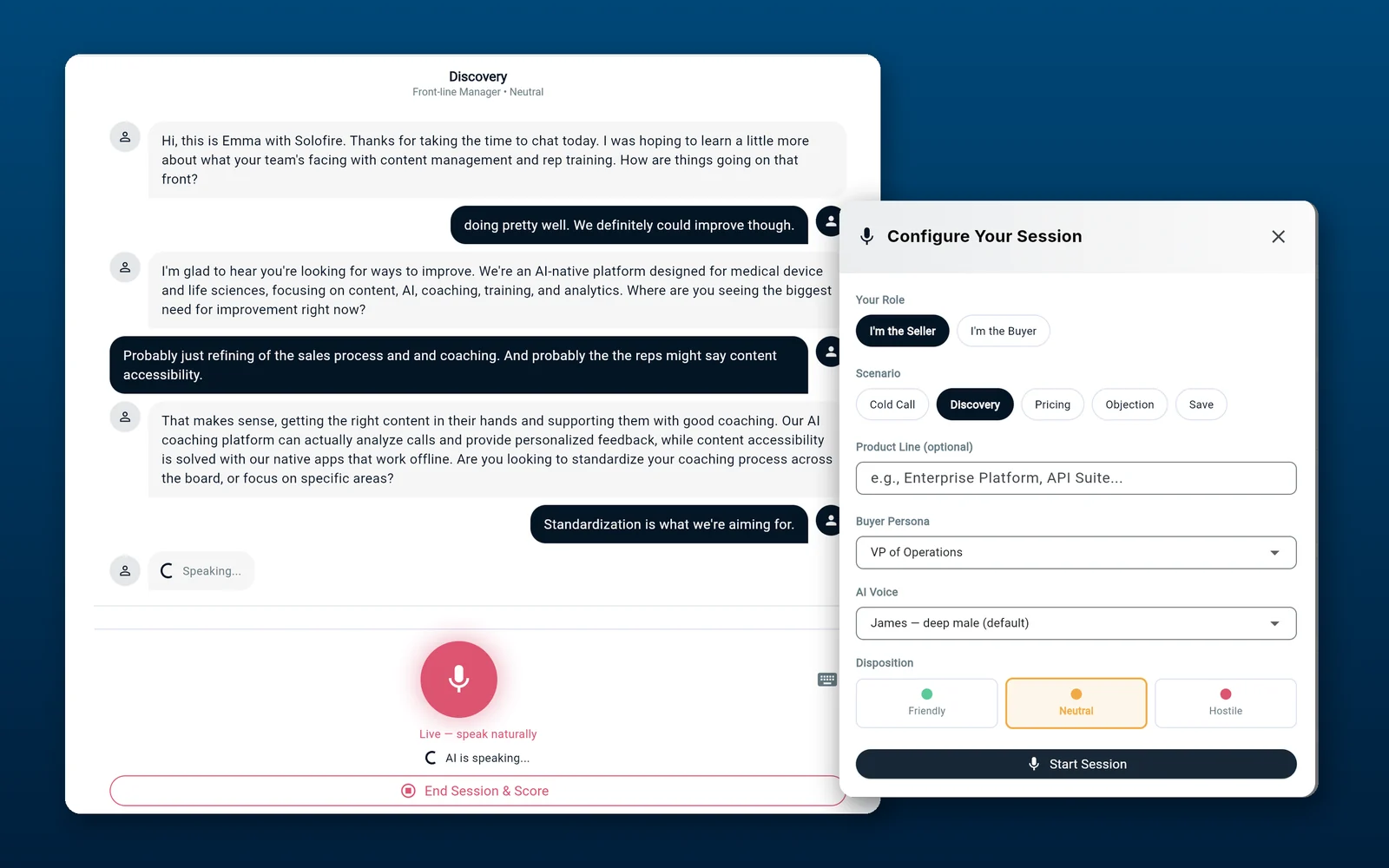
Highspot publishes its packaging, which makes this easy to check. Role Play needs the second tier. Meeting Intelligence, Delivery Intelligence, coaching analytics, the MCP server and the Insights Layer APIs are all top-tier only. SoloFire includes AI — coaching, role-play, content search, auto-tagging — .
Highspot does not publish pricing. Procurement platform Vendr, drawing on 344 purchases as of February 2026, reports an average annual contract value of $60,204, ranging from $16,163 to $178,210. SoloFire's price is on this page: $30 per user per month, everything included.
Highlighted cells show where SoloFire is the stronger fit. Highspot figures are drawn from Highspot's own published pricing page, buyer-reported data on G2 and Vendr, and verified reviews on G2, TrustRadius, Capterra and GetApp.
| Category | SoloFire | Highspot |
|---|---|---|
| Vendor stability | Independent. Same team, same focus, same roadmap. | Merger with Seismic completed August 18, 2026. Combined company operates under the Seismic brand, led by CEO Rob Tarkoff, with two product lines being unified. Roadmap and pricing commitments worth getting in writing. |
| Pricing transparency | Published: $30 per user per month, everything included. | Not published — "contact sales" on all three tiers. Vendr reports an average annual contract value of $60,204 across 344 purchases, from $16,163 to $178,210 (February 2026). |
| Time to live | Hours, not weeks — teams are typically live within a day. Live and recorded training for admins and reps included. | Buyers on G2 report an average of 2 months to implement and 15 months to return on investment. |
| Customer support | Real humans with named touchpoints — you talk to people, not a ticket queue. Onboarding, training, and ongoing help included. | Tiered; premium support reported as a paid add-on ($12K–25K/yr in third-party guides). Post-merger support consolidation with Seismic ongoing. |
| Offline field access | Offline-first by design. Full library available with no connectivity, on native iOS, Android, Windows and Mac apps. | Mobile app supports offline browse and search of content downloaded in advance, organised by Spot. Storage limits, supported file types, and which workflows function offline are not publicly documented. The medical device solution page makes no offline claim. |
| AI packaging | AI coaching, role-play, library search, document chat and auto-tagging included. | Published tiers gate by capability: Role Play requires the second tier; Meeting Intelligence, Delivery Intelligence, coaching analytics, MCP server, Insights Layer APIs, and the Agentforce, Microsoft Copilot for Sales and Slack AI integrations are top tier only. |
| Industry focus | Built for medical device, diagnostics and life sciences. Coaching scenarios ship for indication calls, OR conversations, distributors and payers. | Maintains dedicated medical device and life sciences solution pages naming Abbott, Olympus, Steris and Fresenius Kabi as logos. Published healthcare case studies are payer, telehealth and animal-diagnostics; no medical device manufacturer case study is published. |
| Regulated content | Version control, role- and group-based permissions, and audit-ready records built for teams shipping approved content to the field. | Markets "compliant content" but publishes no MLR review workflow and no Veeva Vault or PromoMats integration. Certifications claimed are SOC 2 Type 2, ISO 27001 and ISO 27701. HIPAA and 21 CFR Part 11 are not claimed. |
| Digital sales rooms | Branded Spaces — trackable, per-prospect pages with file-level engagement and instant alerts. Included . | Digital Sales Rooms are included in the entry tier, with mutual action plans added in the January 2026 release. A genuine strength, not a gap. |
| CRM integrations | Salesforce, HubSpot and Dynamics 365 auto-logging , plus a built-in Contact Manager for reps without a CRM seat. | Deep Salesforce and Dynamics 365 integrations. HubSpot exists in the integration directory but is absent from the main integrations page and thinly documented by comparison. |
| Rep-facing analytics | Pulse Dashboard — every rep sees their own metrics, trending content and contact timeline the moment they open the app. | Recurring reviewer theme. One TrustRadius reviewer describes analytics as "either too high-level or too granular"; G2 reviewers call reporting "unintuitive & difficult to use." |
| Mobile experience | Native iOS, Android, Windows and Mac with full feature parity, built mobile-first. | GetApp reviewers score mobile access 3.7 out of 5 — its lowest sub-score, against 4.6 overall. |
| Content findability | Spark AI searches the whole library — including what is said inside a video — and auto-tags on upload. | Search is the most consistent criticism across G2, TrustRadius and Capterra. Reviewers report results feeling "too broad" as libraries grow, and libraries that "get crowded and disorganized." |
| Setup effort | One centralised library, permissions by user, role or group. Configurations per product line without a services engagement. | Reviewers describe initial setup as "not super easy" and administration as complex in early phases, with significant effort to populate content. |
| Overall reviews | 4.9 average across app stores. A smaller product with a narrower focus. | Genuinely well liked: 4.7 out of 5 on G2 across roughly 1,200 reviews, 8.5 out of 10 on TrustRadius. If breadth is what you need and budget is not the constraint, it earns its ratings. |
Competitor details reflect third-party reviews, published materials, and press coverage as of August 2026 and may change. See also: Seismic · Showpad · the full medtech buyer’s guide, or all comparisons.
Sources: Highspot published pricing and product pages; Vendr marketplace data, February 2026; G2, TrustRadius, Capterra and GetApp reviews and buyer-reported metrics; merger announcements from both companies, 12 February 2026. Figures accurate as of 29 July 2026 and subject to change — verify anything decision-critical directly with the vendor.
If two platforms merge, ask which one gets invested in, and get the answer in your contract rather than on a call.
Ask for licence, implementation, training and the annual escalator as one number, for three years, in writing.
Not "do you have offline" — ask which specific workflows work in a basement OR with airplane mode on, and ask for a demo of it.





We keep side-by-sides for Seismic and Showpad too. If you want the shortest version: see what sales enablement for medical device teams actually has to handle, then check our pricing against whatever quote you are holding.
Before you renew with Highspot, see what a year of real buyer engagement looks like: 26,966 shared links, 50,002 opens, 1,460 hours of viewing time, and what it means for how your reps should send.
SoloFire’s No Double Pay program: sign now, migrate now, use SoloFire free until your Highspot contract ends, with migration included. Start by checking your auto-renewal notice deadline.
Common questions from teams evaluating Highspot alternatives.