SoloFire AI Coaching gives field reps a private, on-demand way to rehearse, with realistic buyer personas, real scenarios, and tone and difficulty managers control. Unlimited voice or text role-plays, in 48 languages, scored on the sales methodology your team already uses: MEDDPICC, SPIN, Challenger, Sandler, BANT, or Open-Probe-Support-Close.
AI sales coaching tools let reps practice sales conversations against an AI that plays the buyer, then score the conversation and tell the rep what to fix. The best ones grade against a sales methodology, check what the rep said against approved product content, and show managers where each rep needs help.
SoloFire AI Coaching does all three for medical device and life science field teams: voice, text or live avatar role-play in 48 languages, scored on MEDDPICC, SPIN, Challenger, Sandler, BANT or your own call model, with every claim the rep makes checked against your approved content library.
Talk to one. Emma is a SoloFire AI coach running a live voice conversation, the same engine your reps practice with. In this demo the roles are flipped: you play the buyer and Emma sells SoloFire, so ask her anything a skeptical buyer would.
With your team, the AI plays the buyer in the scenarios your admin configures, and every session ends with a score against your methodology and specific coaching.
Sales coaching delivers measurable lift, but managers don’t have the hours, and reps don’t get the reps. That’s the gap AI coaching closes: unlimited practice for every rep, visibility for every manager.
of frontline sales managers’ time goes to actually developing reps.
Gartnerof reps say their manager helps them build the skills they need today.
Gartnertypical ramp time for a medical device sales rep.
Industry benchmark; J&J STR program: 12 to 14 mo.Three quick choices, then your rep is in a live coaching session. No scheduling, no manager hand-holding, no scripted walkthrough.
Cardiologist, hospital admin, distributor rep, payer: anyone in your buying cycle.
Friendly, neutral, or hostile. Shadow (with hints), Standard, or Interruption. Match the rep you’re developing.
Discovery, indication conversations, distributor calls, new-product launches, or your own custom scenario.
Reps can speak naturally with the AI buyer or type. The AI stays in character: reluctant, technical, distracted, whatever the persona calls for. Reps can pause anytime to rethink an answer or restart the scenario.
Hello. Priya here. Thanks for joining.
Thanks for making time, Priya. Before I show anything, how does your team decide which tray and instrument sets get standardized across the OR?
It's a committee decision. We look at surgeon preference, clinical outcomes, and, of course, cost.
That makes sense. When cost comes up at committee, what evidence carries the most weight: reprocessing time, case volume, or the contract tier?
All of those are factors. We focus on the total cost per case, so everything that contributes to that number is important.
When the rep ends the session, AI grades the conversation against your team’s playbook, and against your chosen sales methodology: what landed, what fell flat, and what to try next time. No waiting on a manager review, no mystery about why a rep is stuck.
Pick MEDDPICC, SPIN, Challenger, Sandler, BANT, or Open-Probe-Support-Close for a configuration, and every selling role-play is graded on that framework’s own dimensions: a 0 to 100 score for each (or N/A when it doesn’t apply to the call), with the evidence, what was missed, and a question to try next time.
Best for: Complex deals with several stakeholders
Maps each deal against eight elements. A deal is only as strong as its weakest letter.
Best for: Consultative discovery
Four question types that let the buyer voice the case for change before any pitch.
Best for: Changing how the buyer works today
Lead with an insight that teaches, tailor it to each stakeholder, and take control of money and next steps.
Best for: Low-pressure mutual qualification
Agree an up-front contract, find the pain, and qualify for fit instead of persuading.
Best for: Fast qualification on shorter sales
Confirm budget, authority, need, and timeline quickly on every qualification call.
Best for: Pharma and clinical selling, with fair balance
Open with a patient-centred purpose, support with on-label evidence, and close on a specific commitment.
Bar length shows how much each dimension counts toward the methodology score. Dimensions that don’t fit the call type, like Paper Process on a cold call, are left out and the rest re-weighted. Which methodology fits which medtech call? Read the guide →
The AI buyer is briefed with hidden deal facts tied to each dimension and only reveals them when the rep asks well.
Reps know the rubric before they start, and every scorecard points to the next round.
Methodology names are trademarks of their respective owners. SoloFire isn’t affiliated with or endorsed by their creators.
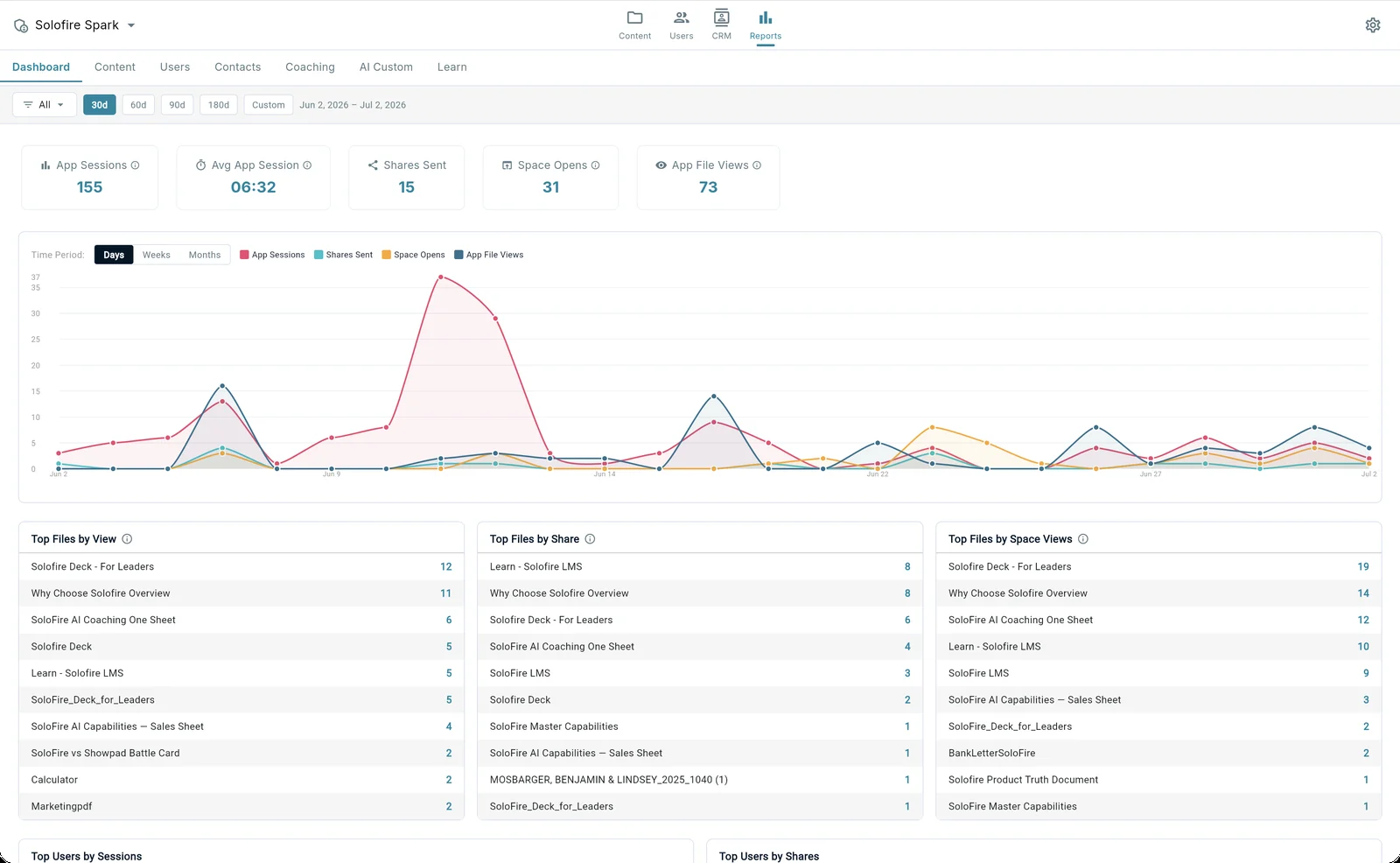
Managers see every coaching session, scores trending over time, scenarios reps run most, and, crucially, which scenarios reps quietly skip. Use it to make 1:1s about specific gaps instead of generic advice.
Reps keep a weekly streak and earn badges for the runs that matter. Managers switch on a leaderboard for any scenario, or run it as a dated challenge, and the team chases a number together. Off by default, one scenario at a time.
The Coaching home counts consecutive weeks with a practice session and shows a shelf of eleven badges, each one explaining what it takes. When a scenario has a leaderboard, the rank sits right on the card, and the scorecard says how far the next place is.
Six of the eleven badges. Each one on the rep's shelf shows its rule and the day it was earned.
Leaderboards are off until an admin switches one on for a scenario. Reps assigned to it see their rank, ranked by best score over 30 days, this quarter, or all time, with ties sharing a place. Set start and end dates and the scenario runs as a challenge.
The scenario leaderboard as a rep sees it, with the numbers from the Acme demo.
SoloFire ships with starter scenarios tuned for medical device and life science teams. Your team can also create custom scenarios for new product launches, indication-specific conversations, payer pushback, or distributor onboarding.
Practice clinical positioning with skeptical specialists.
Budget, capital, and procurement-cycle objections.
Onboarding, line review, and territory-shift talks.
Drill the messaging until every rep is consistent.
Practice the harder economic conversations.
Build any conversation that matches your sales motion.
AI Coaching gets reps ready before the conversation. Live Call Co-Pilot helps during it, listening to the live call and coaching quietly in the background, grounded in the same approved content library.
Key facts, likely objections with suggested responses, and a talking-points checklist, generated from your content before the call starts.
Advice tiles surface relevant facts, suggested next lines, and buyer sentiment reads while the rep talks.
Points check themselves off as the rep covers them, and reps can privately ask Co-Pilot a question mid-call.
Co-Pilot never records audio. The transcript, the cards it showed, and a debrief with follow-up files, a CRM note, and tasks are saved to the rep’s coaching history, and the rep can delete the session.
People learn by doing, and forget fast without reinforcement. Practice-based coaching wins on both counts. It is also the part of the sales readiness framework most programs skip. The idea is not new: see how virtual sales practice improves performance, and why rehearsal beats a one-time workshop.
Reps coach themselves on demand, so managers focus on the 1:1s that matter.
New reps run dozens of sessions in their first two weeks instead of waiting on calendar time.
Every rep practices the same scenarios with the same playbook.
Not “good job” but actual call-by-call observations on what landed and what didn’t.
retention from active practice (vs. 10% from reading, 5% from lectures).
NTL Learning Pyramidof new information forgotten within 24 hours without reinforcement.
Ebbinghaus Forgetting Curvewin-rate lift from dynamic, formal sales coaching.
CSO Insights / Korn Ferryof sales orgs now use AI; 87% of sellers say it makes their job less stressful.
Salesforce, State of Sales 2026Most AI sales coaching tools can run a role-play. The differences show up in how the session is scored, whether the AI knows your product, and what a manager can do with the results. Eight things to check before you buy:
A 0 to 100 score on each dimension of MEDDPICC, SPIN, Challenger, Sandler, BANT or your own framework, with the evidence and a question to try next time. How SoloFire scores it.
Every statement the rep makes is checked against your approved product content, live during the session and again on the scorecard, so practice reinforces compliance instead of drifting from it.
Voice, text or face to face with a live video avatar, in 48 languages, against a buyer who pushes back and holds facts back the way real ones do.
Starter scenarios for indication conversations, hospital admin pushback, payer objections and distributor calls, plus custom scenarios configured from your own playbook.
Session history, scores trending over time, the scenarios reps avoid, and a report of flagged claims, so 1:1 time goes to specific gaps.
Voice and text role-play are included in every SoloFire plan with no minute limits; the live avatar is the one optional add-on at $15 per user per month. See pricing.
A Practice lesson puts a role-play at the end of a training course, with a pass rule of any completed session or a minimum score, so certification covers the conversation, not just the quiz.
Attach product sheets, clinical summaries or call plans from your library to a scenario. Reps read them on the briefing screen before the session starts, the way they would prep for a real call.
Comparing vendors? See how SoloFire differs from Mindtickle and Allego, or browse the full comparison hub.
Common questions from sales leaders and enablement teams.