

Short answer: Sales enablement for manufacturing means giving everyone who sells your products, including employees, distributors, dealers and independent reps, the current spec sheets, approved claims, training and buyer-ready content they need, in the field and offline. It matters more than in most industries because manufacturers sell complex products through partners they don't employ, to buying committees that do their own research first.
What is sales enablement in manufacturing?
It is the system that gets the right product knowledge to the right seller at the moment a buyer asks for it. In manufacturing that system has to cover people outside your payroll: distributor reps who carry five other lines, dealers who sell your equipment once a quarter, and independent rep firms. A good program answers three questions for every seller: what can I show, what can I say, and have I been trained on it.
SoloFire was built for medical device and life science manufacturers, which face the hardest version of this problem: regulated claims, distributor networks and reps working in hospitals with no signal. The lessons carry over to any manufacturer that sells through a channel.
Why do manufacturers need sales enablement now?
Buyers have changed faster than most manufacturers' sales tools.
- Buyers research without a rep. Gartner found in 2026 that 67% of B2B buyers prefer a rep-free experience.
- But they still check with one. A second Gartner survey found 69% of B2B buyers prefer to validate AI-generated insights with sales reps, and buyers used an average of seven information sources in a recent purchase. When the buyer finally talks to your rep, the rep has to be right.
- More people decide. Forrester's 2026 State of Business Buying found 13 internal stakeholders and nine external participants influence buying decisions across industries.
- More channels. McKinsey reports B2B customers use an average of ten interaction channels, up from five in 2016.
- Distributors carry less of the sale. In a 2025 survey of industrial buyers reported by Digital Commerce 360, 58% of purchases happened outside traditional distributor relationships. Partners still matter, but they can no longer be your only path to the buyer.
How do you enable distributors, dealers and independent reps?
Partner reps are not employees, and they won't use a tool that feels like one. What works:
- Make it faster than asking you. If the platform shortens time to find and share the right file, usage goes up. We cover this in how to get distributors to actually use a sales enablement platform.
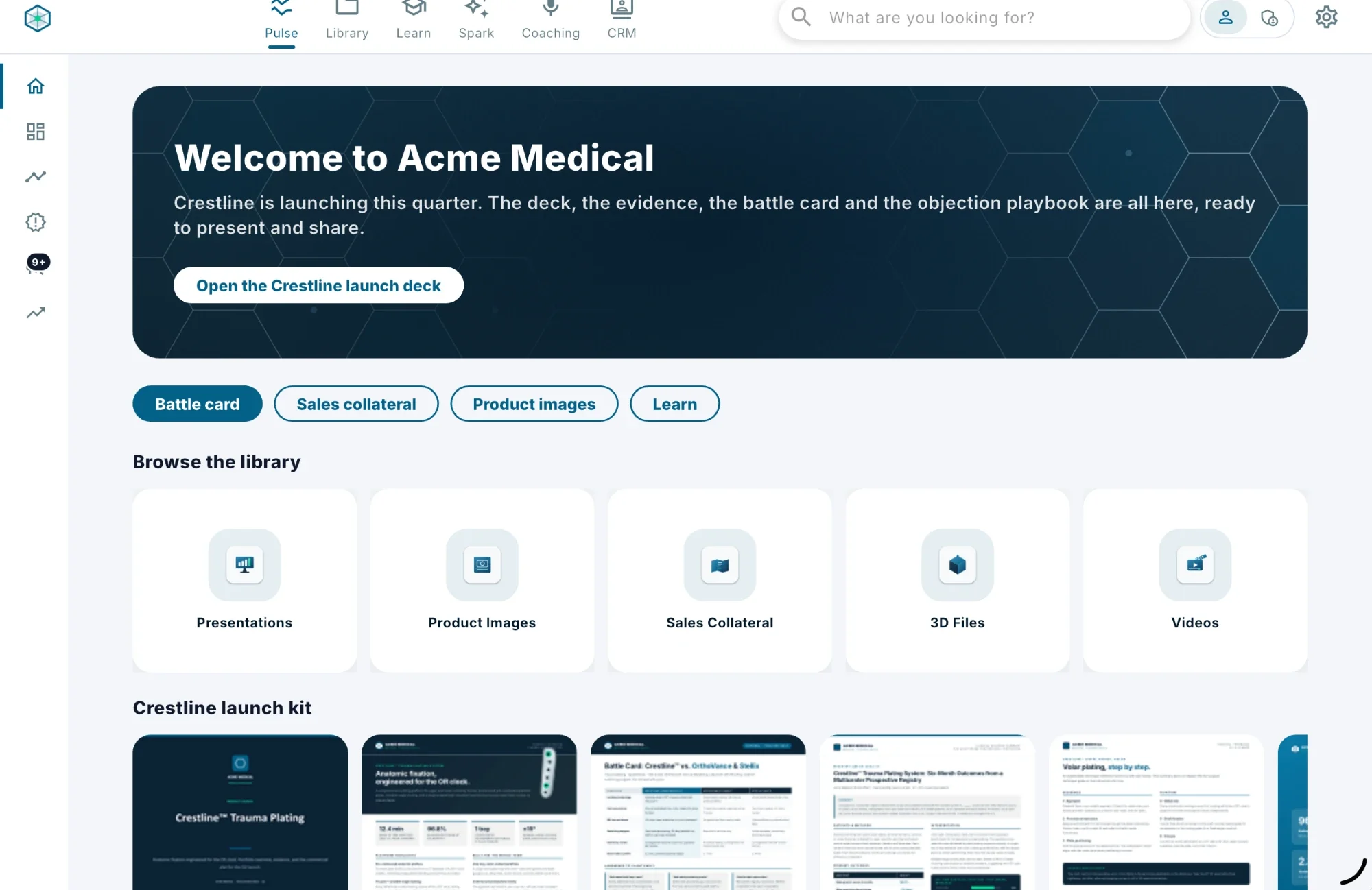
- Give them their own branded space. A partner should see only your current, approved content for their territory, not your whole library.
- Train without an LMS seat. Send a course by name and email and track completion, so a dealer rep can certify on a product without joining your HR systems.
- Price seats for how they sell. A rep who sells your line twice a month should not cost what a full-time employee costs. SoloFire charges distributor reps a lower rate than payroll reps.
How do you keep spec sheets and literature current across regions?
The most expensive content problem in manufacturing is an old spec sheet in a buyer's inbox. Three rules prevent it:
- One active version. When a file is replaced, the old version archives everywhere it was shared, including on partners' devices.
- Expiry dates on anything that can go stale. Pricing sheets, certifications and test reports get an end date when they are published.
- Language and region as filters, not copies. CSA Research found that 66% of business buyers would pay up to 30% more for a localized product. Tag each file by region and language so reps only see the right one.
For regulated products, the approved claim matters as much as the file. Our guide to content governance for regulated field teams covers approvals, expiry and audit trails.
Does sales enablement work offline on plant floors and job sites?
It has to. Plants, job sites and hospitals often have poor or blocked connectivity, and a rep who can't open a file in front of the buyer loses the moment. Look for native apps that store the rep's approved library on the device and sync when they reconnect. SoloFire was built offline first for exactly this reason: medical device reps work in operating rooms where phones don't get a signal.
How do you sell technical products to a buying committee?
- Bring the engineering content. Spec sheets, CAD drawings, test data and 3D models answer the engineer's questions without a follow-up call. SoloFire displays 3D product models you supply as .glb files.
- Send one link, not ten attachments. A Space is a branded page with the rep's profile and the exact files for that buyer. Every person on the committee sees the same current versions.
- Know what they opened. View tracking shows which files were opened and for how long, so the rep can follow up on the pricing sheet that got read instead of the test report that didn't.
What does a 90-day manufacturing sales enablement rollout look like?
| Days | Goal | Who owns it | Done when |
|---|---|---|---|
| 1 to 30 | Clean the library: one current version of every spec sheet, brochure and price list, tagged by product, region and language | Marketing | Direct reps use it daily; no old versions in circulation |
| 31 to 60 | Train and certify direct reps on the top three products; launch Spaces for buyer follow-up | Sales leadership | Certification complete; first buyer engagement data |
| 61 to 90 | Open partner access: distributor libraries, product courses by email, partner seat pricing | Channel manager | Top distributors active weekly; content requests to marketing drop |
What does manufacturing sales enablement software cost?
Most platforms price per user and do not publish prices; buyers report median contracts of roughly $32,000 to $60,000 a year. See the details in our sales enablement software pricing guide. SoloFire publishes its price: $30 per user per month with everything included, and a lower rate for distributor reps.
Manufacturing sales enablement checklist
- Every seller, including partners, can find the current spec sheet in under 30 seconds.
- Old versions archive automatically everywhere they were shared.
- Reps can show content with no connection.
- Partners see only their approved content, under your brand or theirs.
- Dealer reps can finish product training without an LMS seat.
- Reps share one tracked link per buyer and see which files were opened.
- Regulated claims and documents carry approval and expiry dates.
- Partner seats are priced for how often partners sell your line.
Frequently asked questions
What is sales enablement in manufacturing?
It is the system that gives every seller of your products, including distributors, dealers and independent reps, current content, approved claims and training, in the field and offline.
How do manufacturers manage content across distributors?
Give each distributor a branded library limited to its approved content, keep one active version of every file so updates replace old copies everywhere, and track which files partners use.
Does sales enablement software work offline?
The right platform does. Native apps that store the rep's library on the device let reps show content on plant floors, job sites and in hospitals with no signal.
How do you train dealer reps who aren't employees?
Send product courses by name and email and track completion, so dealer reps can certify without an LMS seat or access to your internal systems.
How do you measure manufacturing sales enablement?
Track content found and shared per rep, partner activity by week, buyer engagement on shared content, certification completion and the drop in content requests to marketing. See how to measure sales enablement.