
Sales methodology training usually ends the same way. The company pays for a two-day MEDDPICC, SPIN, or Challenger workshop, reps leave with a pocket card, and within a quarter most calls sound the way they did before. The methodology didn't fail. Nobody practiced it between live calls, and nobody scored real conversations against it.
This post covers why methodology training fades, which framework fits which medical device conversation, and what an AI role-play has to do before its score tells a rep anything useful about MEDDPICC, SPIN, Challenger, Sandler, BANT, or a pharma-style call model.
Why does sales methodology training fade after the workshop?
A workshop teaches the vocabulary. A sales call needs reflexes, and a reflex only comes from repeating the move until it happens without thinking. Most teams never build that repetition, for three reasons.
Practice is rare and public. Role-play happens at the national sales meeting, in front of peers and a manager. Reps perform instead of experimenting, and they get maybe two turns a year.
Feedback isn't framed in the methodology. A ride-along ends with “good call, push harder on next steps.” That's advice, but it isn't MEDDPICC. If your team is trained on eight letters and coached on gut feel, the letters stop mattering.
Medtech reps get few chances. A surgeon gives you five minutes between cases. A value analysis committee meets monthly. When the real calls are rare and high-stakes, reps fall back on whatever feels safe, and the methodology is the first thing to go.
The fix isn't another workshop. It's frequent, private practice that's scored in the methodology's own terms, so reps hear “you never found the economic buyer” instead of “solid discovery.” That's the job of AI sales coaching when it's set up properly.
Which sales methodology fits which medical device conversation?
Most teams standardize on one framework, and that's the right call for coaching consistency. But each framework was built for a particular kind of sale, and it helps to know where yours is strongest. Here's how the six most common ones map to the conversations medtech and life science reps actually have.
| Methodology | What a call is scored on | Built for | A medtech call to practice it on |
|---|---|---|---|
| MEDDPICC | Metrics, Economic Buyer, Decision Criteria, Decision Process, Paper Process, Identify Pain, Champion, Competition | Complex deals with several stakeholders | A capital equipment deal that needs a surgeon champion, a CFO signature, and a value analysis committee review |
| BANT | Budget, Authority, Need, Timeline | Fast qualification on shorter sales | Following up a trade-show lead to decide whether it's worth an in-person visit |
| SPIN Selling | Situation, Problem, Implication, and Need-Payoff questions | Consultative discovery | A first meeting with an OR nurse manager about turnover time or supply waste |
| Challenger | Teach, Tailor, Take Control | Deals where the buyer has to change how they work | Converting a surgeon who has used the incumbent device for ten years |
| Sandler | Up-Front Contract, Pain, Budget, Decision, Fulfillment, Post-Sell | Low-pressure mutual qualification | A practice owner or ASC administrator who has been oversold before |
| Open-Probe-Support-Close | Open, Probe, Support, Close, plus fair balance | Pharmaceutical and clinical selling | An on-label conversation with a clinician, with safety presented alongside efficacy |
Open-Probe-Support-Close is the one generic sales tools tend to skip, and it's the one many pharma and clinical teams already run. It also adds something the others don't have: fair balance, where the rep presents safety alongside efficacy. For a regulated team, that's worth scoring on every call, not just checking at MLR review.
What should an AI role-play actually score?
A single number like “Discovery: 72” doesn't tell a MEDDPICC team anything. To coach a methodology, a role-play scorecard needs four things:
- One score per dimension. Each letter or step is graded on its own, so a rep can see that Metrics was strong and Champion was missing.
- Evidence. A quote from the rep's own conversation shows why they got the score. Without it, reps argue with the grade instead of learning from it.
- What was missed, and a question to try next time. “You never asked who approves spend over the department threshold. Next time, try asking who else needs to sign off before a purchase this size goes through.”
- “Not applicable” where it belongs. Nobody should lose points for skipping Paper Process on a cold call. Scoring has to know what kind of call it's looking at, and weight only the dimensions that apply.
Weighting matters too. Some parts of a framework decide deals more than others. A MEDDPICC scorecard that gives Paper Process the same weight as Identify Pain will teach reps to chase procurement details before they've found a reason to buy.
Why does the AI buyer need to hide something?
This is where most role-plays fall apart, AI or human. A buyer who volunteers everything makes every rep look good. A manager playing the buyer either gives the answers away or stonewalls, depending on their mood.
A methodology role-play works when the buyer holds specific deal facts and only gives them up when the rep asks the right question. In a MEDDPICC session, for example, the buyer might know that:
- Anything above a spend threshold needs approval from someone above them, and they'll name that person if asked.
- A procurement or security review adds weeks, and nobody has put it on the timeline.
- A competitor, or doing nothing at all, is still on the table, and there's one reason it's attractive.
- A colleague would personally benefit from solving the problem and has the approver's ear. That's a potential champion.
A low Economic Buyer score then means something concrete: the approver existed, and the rep never asked. That's a far better coaching conversation than “be more thorough in discovery.”
How do you turn one scorecard into a skill?
A scorecard shows where a rep is. These practice patterns move them forward:
- Know the rubric before the call. Show the rep which dimensions they'll be scored on, and how much each one counts, before they start. Practice gets deliberate instead of hopeful.
- Drill the weakest dimension. After a full session, run a short round against the same buyer that focuses on the lowest-scoring dimension. Five minutes on Champion alone beats another full call where it gets lost again.
- Run the same deal again. Repeat the session with the same buyer and the same hidden facts, then compare scores dimension by dimension. The change from one attempt to the next is the most motivating number a rep will see.
- Track the framework live. In voice or video practice, a running tracker shows which dimensions the rep has covered and how many deal facts they've uncovered, so they can fix it before the call ends.
- Practice the real deal. Brief the AI buyer from an actual open opportunity (the account, the stage, the contacts, recent activity) the night before the meeting. Then the practice is the preparation.
For which conversations to put these on, our library of medical sales role-play scenarios is a good starting set. Every one of them works with any of the frameworks above.
How does SoloFire score AI role-play on a sales methodology?
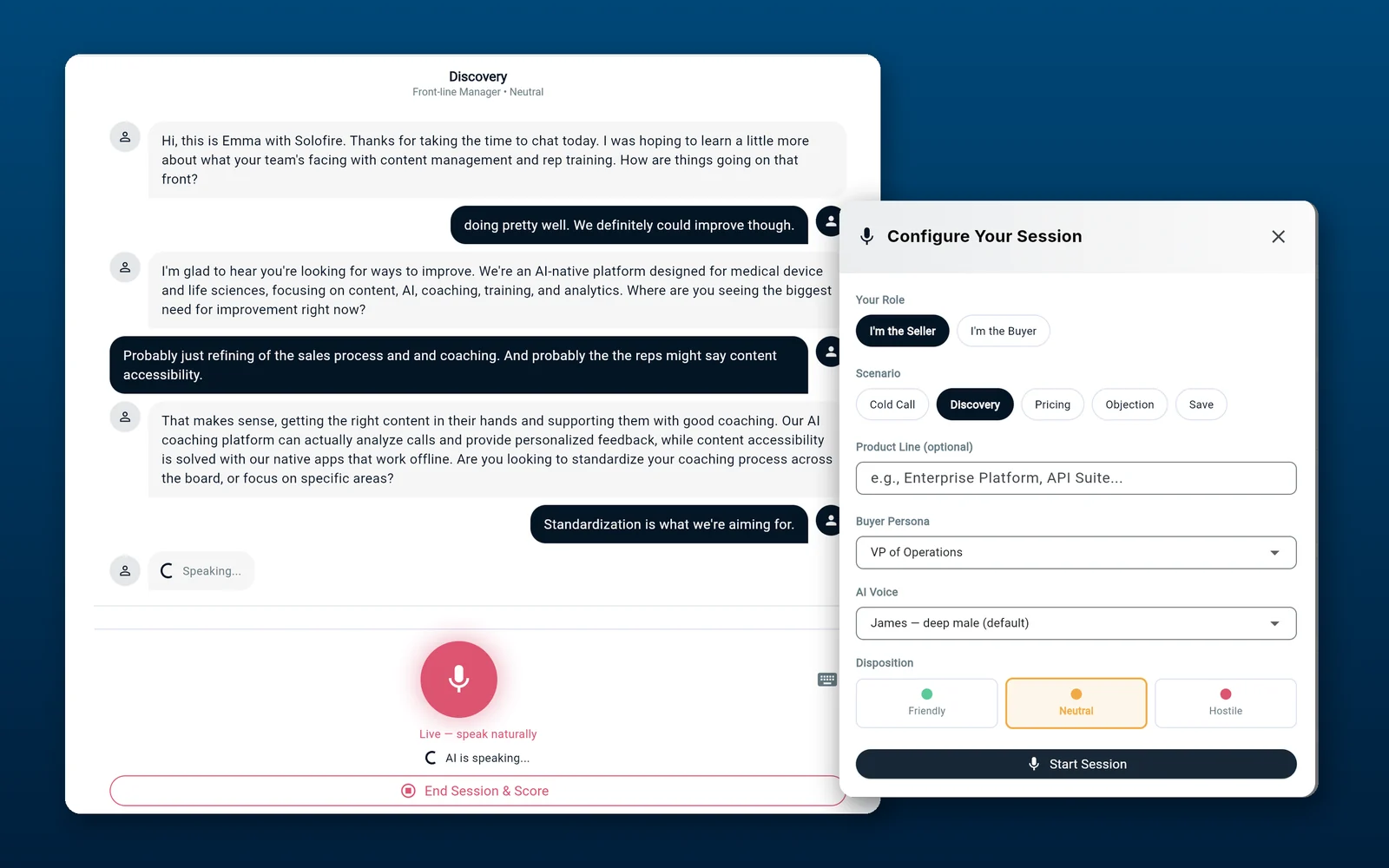
SoloFire AI Coaching now does all of the above. An admin picks a sales methodology for each configuration: MEDDPICC, BANT, SPIN, Challenger, Sandler, or Open-Probe-Support-Close. From then on, every selling role-play in that configuration is scored on the framework's dimensions, 0–100 or N/A, each with the evidence, what was missed, and a question to try next time, rolled up into a weighted methodology score. The AI buyer is briefed with hidden deal facts, and coaching tips mid-session use the framework's terms. The standard scores on discovery, objection handling, closing, and product knowledge still apply, along with any custom criteria your team adds.
Reps see “what you'll be scored on” before every session and get a one-click drill on their weakest dimension afterward. Managers get a heatmap of every rep against every dimension, with a team-average row and CSV export, so a 1:1 can start with “let's work on Decision Process” instead of a general impression. The practice runs by voice, by text, or face-to-face with a live AI avatar.
If your team runs its own framework, or a variant of one of these, SoloFire can set it up as a company-specific methodology built from your playbook.
What does good look like?
Three months in, a team that practices its methodology this way looks different in small, specific ways. Reps name the economic buyer on the forecast call without being asked. New hires can see exactly how far they are from the team's average on each dimension, long before their first lost deal shows them. Managers spend 1:1s on one dimension per rep, chosen from data rather than memory. And when the company invests in the next methodology workshop, the content has somewhere to go the Monday after.
The framework your team paid to learn is only as good as the number of times reps run it before the call that matters.
Frequently asked questions
Can AI score a sales call on MEDDPICC?
Yes. In SoloFire AI Coaching, a role-play scored on MEDDPICC gets a separate 0–100 score for each of the eight elements, with evidence from the conversation, what was missed, and a suggested question. Elements that don't apply to the type of call are marked N/A and left out of the weighted total.
Which sales methodologies does SoloFire AI Coaching support?
MEDDPICC, BANT, SPIN Selling, Challenger, Sandler, and Open-Probe-Support-Close. An admin picks one per configuration, so different teams (say, capital equipment and disposables) can practice different frameworks.
Does methodology scoring replace our sales methodology training?
No. It's the practice layer that comes after training. Your trainer or methodology partner teaches the framework, and AI role-play gives reps the repetition and the framework-specific feedback that make it stick.
What happens to past scores if we change methodologies?
Each session keeps the methodology it was started with, so historical scorecards and reports don't mix dimensions from different frameworks.
Methodology names are trademarks of their respective owners. SoloFire isn't affiliated with or endorsed by the creators of any methodology named here. Our scoring rubrics are our own reading of each published framework.