
A medical device sales rep takes nine to twelve months to reach full productivity, and the large manufacturers' entry programs run twelve to fourteen. Most of that time is not training. It is waiting: for credentialing to clear, for the next case day, for a surgeon with ten spare minutes, for the committee to meet. Sales onboarding that shortens ramp works on the waiting, not on the length of the course list.
Sales leaders tell us some version of "our ramp time is horrendous" on most first calls, and one technical team of eight sellers plans on eighteen months. This guide takes the number apart: where the months go, what each one costs, which can be cut, and what a new hire sales training plan and the sales training and onboarding software behind it have to do.
What does a slow ramp actually cost?
Finance already pays for ramp; it just does not see the line item. Three things add up: the salary and any guaranteed variable paid before quota, the recruiting and manager time around the hire, and the margin on revenue a ramping rep does not yet produce. With medical device defaults (an $85,000 base, $185,000 on-target earnings, a $1.5M territory quota and a nine-month ramp), cutting two months off the ramp is worth about $78,000 per rep in recovered margin and manager time. Our rep ramp cost calculator shows the formula, so you can run your own numbers and quote whichever line your CFO recognizes.
There is a second cost that never reaches the calculator. A rep who is not ready delays the conversations they are nervous about, and a deal that waits for the right conversation usually ends in "no decision." For a small team, a month of ramp is also a month in which an open territory has no one working it at full pace. That is why the onboarding plan is a revenue decision, not an HR one, and why SoloFire runs training in the same app reps sell from.
Why does medical device sales onboarding take nine to twelve months?
Cross-industry benchmarks are shorter than you might expect. Software account executives took a median 6.2 months to ramp in The Bridge Group's 2026 study, the longest in that study's history. Older cross-industry work put full productivity at about nine months and top performance at fifteen. Device and diagnostics teams sit at the long end, and the sales training and coaching statistics we track show why: Johnson & Johnson MedTech's entry-level sales programs run twelve to fourteen months and Medtronic's spine associate cohort runs twelve. Four things stretch the clock.
- Credentialing gates the building. Vendor credentialing, immunizations, background checks and facility policies can take weeks, and a rep with perfect product knowledge who is not cleared cannot get past the loading dock.
- The learning is procedural, and someone else sets the schedule. A rep learns the OR by being in the OR. Case days are set by surgeons and schedulers, so a motivated new hire cannot simply do more of them.
- The economic conversation has to be taught before it can be rehearsed. Value analysis committees ask about evidence, cost and contract status. Most programs teach the product and leave the economics to be picked up in the field, which is the slowest classroom there is.
- At-bats are scarce. A surgeon gives a rep a few minutes, rarely. Each conversation carries weight, so reps postpone the ones they are not ready for, and ramp quietly extends.
Credentialing is fixed. Case cadence is mostly fixed. The other two are where onboarding design makes the difference.
Which months can you cut, and which can you not?
Treat the ramp as phases with different levers rather than one number to shrink.
| Phase | Typical length | Can it be shortened? | What moves it |
|---|---|---|---|
| Credentialing and compliance | 2 to 6 weeks | Only by starting early | Assign the modules before day one and track expiry dates so nothing lapses mid-ramp |
| Product and procedure knowledge | 4 to 8 weeks | Yes, materially | Sequence the material, test by retrieval instead of attendance, keep every approved asset in one place |
| The economic case and the committee | 2 to 4 weeks | Yes | Teach it as its own stage with the finance and health economics material that already exists |
| First conversations and first cases | 8 to 20 weeks | Partly | Rehearse each conversation before the first real one; shadow with a purpose; manager feedback within a day |
| Reinforcement to day 180 | Ongoing | Yes (retention) | Spaced retrieval on the highest-stakes content, refreshers when labels or evidence change |
The five stages themselves, and what each one should teach, are laid out in our guide to building a med device sales training program. This post is about the clock.
What should a new hire sales training plan look like, week by week?
A plan without gates is a calendar. The version below is built around what has to be true before the next stage opens, because that is what shortens ramp: nobody waits for week eight if they cleared the gate in week six, and nobody is sent into a case they have not rehearsed.
| Window | Focus | Gate to the next stage |
|---|---|---|
| Pre-start to day 10 | Credentialing modules, systems access, a guided tour of the content library | Cleared for the first target accounts. Can find any approved asset in under a minute. |
| Weeks 2 to 4 | Anatomy, indications, technique, the clinical evidence, the competitive landscape | Passes the knowledge check without notes and walks a manager through the procedure. |
| Weeks 4 to 6 | The economic case: committee mechanics, procurement priorities, contract and GPO status | Builds a committee-ready economic summary from approved materials. |
| Weeks 5 to 8 | Rehearsal: the skeptical surgeon, the price-driven materials manager, the committee's economic challenge, the incumbent objection | Handles all four scenarios with a manager sign-off, not a self-report. |
| Weeks 8 to 12 | Supervised field time, then independent calls | First credentialed account visit and first independent call logged. |
| Day 90 to 180 | Spaced reinforcement, re-certification where required, refreshers on new evidence | 90-day retrieval check holds. Performance at 180 days matches certification day. |
Keep the windows honest. If credentialing in your accounts takes six weeks, say six weeks and start it before the offer letter is signed, not after.
How do you accelerate sales onboarding without lowering the bar?
Five levers, in the order we would pull them.
- Sequence with gates instead of assigning a pile of courses. A learning path that unlocks the next course when the last one is passed removes the weekly manager nudge and stops reps from skipping to the parts they like. Order matters: product foundations, then evidence, then the economic case, then rehearsal.
- Put the training next to the content reps sell with. New hires should not learn a separate system to learn the product. When the course, the clinical deck it teaches and the one-pager they will leave behind sit in the same app, "which article should I be using for this?" has an answer in the place they are already looking.
- Rehearse before the first real conversation. In Salesforce's 2025 State of Sales research, 44% of reps said they do not get enough opportunities to role-play before customer calls. Practice alone is not the point; practice with feedback is. A 2014 meta-analysis of deliberate practice found practice by itself explains a small share of performance in professional work, which is why the rehearsal stage needs a scorecard and a manager, not just a quiet room. This is the stage AI role play for reps is designed to compress, because a rep can run the committee conversation ten times before the real one instead of once.
- Space the retrieval, and stop relying on the bootcamp week. A 2015 replication of the forgetting curve found only 12.5% of memory savings remained after 31 days without reinforcement. The techniques with the strongest evidence for retention are spaced practice and practice testing. Short knowledge checks at week two, week six and day ninety beat a long exam at the end of bootcamp.
- Measure ramp milestones, not completions. Course completion says a rep clicked through. Track time to first credentialed account visit, time to first independent call, time to first committee presentation, and 90-day retention checked by retrieval. If you are still defining the yardstick, start with how to measure sales readiness.
What should sales onboarding software do?
The question we hear most in evaluations is "is there proof it shortens ramp time?" The honest answer from any vendor should be a mechanism, not a case study. Vendor-reported ramp results are excluded from our statistics page for a reason: the comparison cohort is never shown. Ask instead how the tool changes the levers above, then run your own test. Put the next cohort on the gated plan and measure time to first independent call against the last two cohorts. That is proof you can take to finance.
Score each candidate against this list.
- Learning paths with unlock gates: the next course opens only when the previous one is passed, and the manager can see where each rep sits on the path.
- Imports the SCORM courses you already own (1.2 and 2004) and builds new courses from approved content without an authoring tool.
- Knowledge checks with a passing score, retakes and randomized questions, so a check measures recall rather than attendance.
- Certifications and records that show who completed which course version, when, with what score, exportable for audits and vendor credentialing.
- Role play against your own approved content with a scorecard, so rehearsal happens before the surgeon conversation and the feedback is specific.
- Runs in the same app as the content library, on the phones and tablets reps carry, so training and selling are one place and one login.
- Announcements that reach the field inside the app, because reps do not read onboarding email.
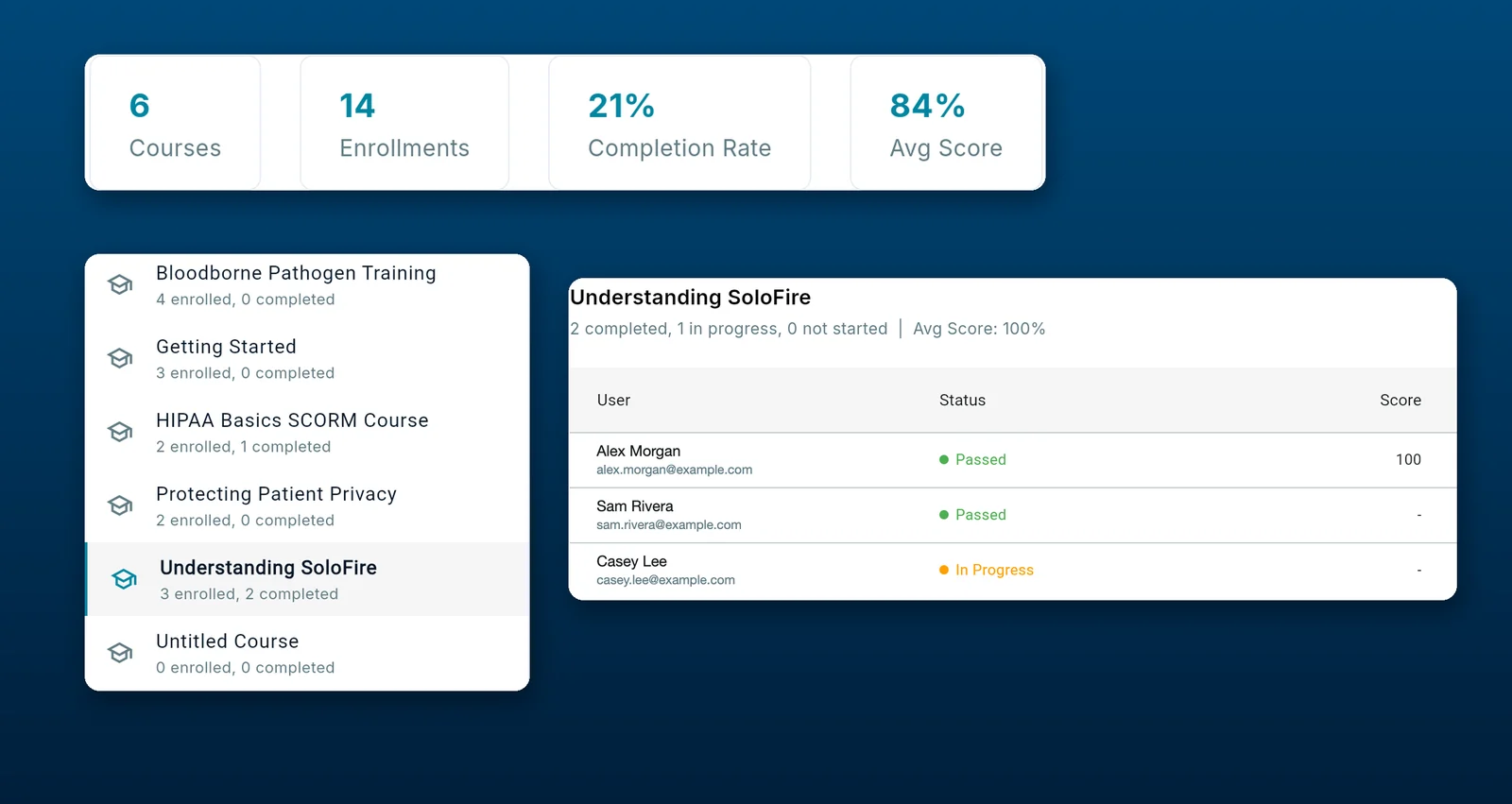
- Reporting a sales leader will actually open: enrollments, completion, scores and stalled reps on one screen.
SoloFire covers this list with learning paths and certifications, a course builder that writes knowledge checks from your existing materials, and AI role play scored against the same approved content, all in the app reps already use in the field. The requirements questions that usually follow, about SCORM versions, xAPI and whether you still need a corporate LMS of record, are answered in our guide to SCORM, learning paths and LMS requirements.
What good looks like
A rep starts on a Monday in January already cleared for her first three accounts, because the credentialing modules went out with the offer letter. By the end of week two she can find any approved asset faster than the tenured reps. In week six she presents an economic summary to her manager that was built from the same materials the health economics team uses. By week eight she has handled the committee's cost challenge ten times against a scored persona and once in front of her manager, who signed off. Her first independent call is in week ten, not month five.
At day ninety a short retrieval check shows the clinical evidence stuck. At day 180 the manager has not opened a spreadsheet once; the path shows where she is and where the two reps who started with her have stalled. Ramp for the cohort is measured at seven months, and finance can see what the two months were worth.
The place to start is the number. Run your own ramp through the calculator, put gates on the plan you already have, and move rehearsal ahead of the first real conversation. If you want to see what a gated learning path and scored role play look like with your own content, see SoloFire with your materials.
Frequently asked questions
How long does it take a medical device sales rep to ramp?
Nine to twelve months to full productivity is the common range, and the large manufacturers' entry programs run twelve to fourteen months. Software account executives ramp in about six months by comparison. Credentialing, procedural learning and scarce surgeon time explain the gap.
What is sales onboarding software?
Software that sequences, delivers and tracks a new hire's training: learning paths, courses and SCORM packages, knowledge checks, certifications and records, usually with rehearsal tools and manager reporting. For field teams it works best inside the same app that holds the sales content, so reps learn and sell in one place.
How do you measure sales onboarding success?
By ramp milestones rather than completions: time to first credentialed account visit, time to first independent call, time to first committee presentation, 90-day retention checked by retrieval, and time to quota pace. Compare each cohort with the two before it.
Does AI role play shorten ramp time?
The evidence that holds up is for practice with feedback, which AI role play makes available on demand. Reps who rehearse a conversation many times with a scorecard before the real one are ready for it sooner. Measure the effect on your own cohorts rather than relying on vendor-reported results.