
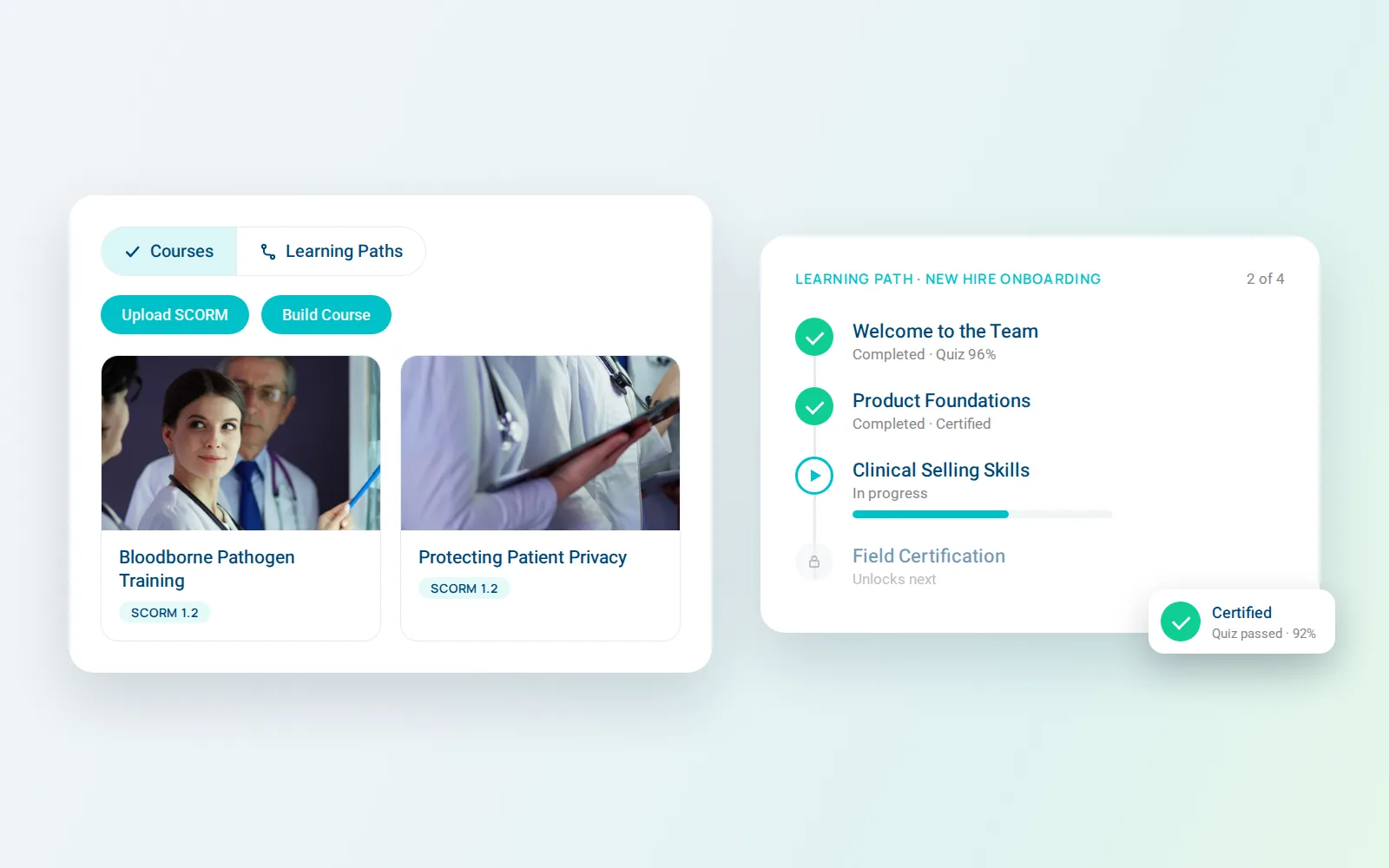
An LMS integrates with a sales enablement tool in one of four ways: shared sign-on so reps have one identity, links or embeds that point courses at the content library, a data connection (SCORM, xAPI or an API) that moves completion records between systems, or consolidation, where training runs inside the enablement platform and your existing SCORM courses are imported. Which one you need depends on where your training record of truth has to live, and how often your field content changes.
For a medical device or life science team, this is not IT plumbing. A rep trained in one system and selling from a deck in another carries two versions of the truth. When the label changes, someone has to update both and prove the rep saw the new one.
That gap shows up in front of a surgeon, a lab director or an auditor. It is why SoloFire puts sales training and onboarding in the same app reps sell from. Whichever route you take, the requirements below are the ones to write down before you talk to any vendor, including us.
How does an LMS integrate with a sales enablement tool?
"Integrates with" can mean four different things. Write down which one you are buying.
| Pattern | What it does | What it does not do | Ask about |
|---|---|---|---|
| Single sign-on and provisioning | Both systems trust the same identity provider, so a rep has one login | Move content or completion data | Whether new hires are provisioned automatically or created by hand |
| Links and embeds | A course links to a file in the enablement library, or the app links to a course | Track what the rep actually opened, or survive a file being moved | Whether a link points at the current version or a fixed copy |
| Completion data sync | Course results flow between systems through SCORM, xAPI or a vendor API | Keep the content itself in step | Which direction data flows, how often, and what happens when a sync fails |
| Consolidation | Training runs inside the enablement platform; SCORM courses are imported, not connected | Replace a corporate LMS your quality or HR team requires | Whether you still need completion data sync for an LMS of record |
Single sign-on is table stakes. The real decision is between syncing two systems forever and moving sales training to where reps already work.
What is SCORM, and do field reps need it?
SCORM (Sharable Content Object Reference Model) is a set of technical standards, maintained by the U.S. Department of Defense's Advanced Distributed Learning (ADL) Initiative, that lets a course built in one tool run inside another system and report results back. The system launches the package, and the course reports completion, score, time spent and a bookmark.
Reps never think about SCORM. Your training team should, because:
- You already own SCORM courses. Compliance modules and agency-built product training usually arrive as SCORM packages, and rebuilding them is expensive.
- It produces evidence. Pass or fail, score and completion date are what a training audit asks for.
- It keeps you portable. A SCORM course should run in your next system too.
What to ask a vendor about SCORM:
- Which versions: SCORM 1.2, SCORM 2004, or both?
- Does resume and bookmarking work? Reps get interrupted between cases.
- Does pass or fail come from the package's own mastery score?
- Is time in the course recorded?
- Does the course play on the phone or tablet the rep carries, not just a desktop browser?
- Do you support xAPI? Support varies widely across sales platforms, so ask directly if you own xAPI content.
Do field sales teams need learning paths, or just course assignments?
A course assignment gives a rep a list. A learning path gives them an order: the next course unlocks only when the one before it is complete.
For medical device onboarding, order matters: product foundations, then clinical evidence, then objection handling, then certification. A list lets a new hire jump to the easiest quiz. A path makes the sequence the default, without a manager pushing assignments every week.
What a learning path should do:
- Release courses sequentially, with no skipping ahead
- Mix imported SCORM courses and courses you build yourself in one path
- Require a passing quiz score before the next course unlocks
- Assign different paths by team, role, product line, region or distributor channel
- Show managers where every rep is on the path, and who has stalled
If you are still designing the curriculum itself, start with building a med device sales training program, then choose the system that can run it.
Should training live in your LMS or your sales enablement app?
A corporate LMS is built for company-wide training: policy courses, HR compliance, quality records. It is a weaker fit as a learning management system for sales teams, where product training changes with every launch, reps learn on a phone, and the course should sit next to the content they present.
There are good reasons to keep the corporate LMS as the record: your quality system may require it, or HR may need one place for all training. Then decide which courses live where, and whether sales completions must flow back.
SoloFire is designed for this split. Courses run in the same app as the content library: build them from approved assets, or import SCORM 1.2 and 2004 packages with resume, bookmarking and scoring supported (xAPI is not). You can sequence courses into learning paths and certifications, and share a course with an outside person, such as a distributor rep, using a name and email with no account to set up. Training needs a connection; the content library works offline. Single sign-on and CRM connections are covered on our CRM integrations page, and the background is in the SoloFire LMS launch.
What should a field sales training requirements checklist include?
Paste this into your requirements doc and score each vendor.
Course standards
- Imports SCORM 1.2 and SCORM 2004 packages as they are
- Resume and bookmarking for interrupted sessions
- Pass or fail from the package's mastery score, with scores recorded
- xAPI support, if you own xAPI content
- A built-in course builder for short product updates, no authoring tool required
- Quizzes with passing scores, retakes, and every attempt recorded
Sequencing and assignment
- Learning paths with sequential unlock
- Assignment by team, role, product line, region and distributor channel
- Courses shareable with people outside your user base, with tracking
Field reality
- Runs on the devices reps carry: iOS, Android and web
- A clear answer on offline: which parts work with no signal (test it in airplane mode)
- One login through your identity provider, with automatic provisioning
- Training next to the approved content reps sell from
Records and reporting
- Completion, score and progress by rep, team and company
- Certificates of completion retrievable per rep
- Export or sync of completion records to your LMS of record, if required
- Dated history of who completed which version of a course
Governance
- Course lessons update when the source asset is revised
- Retired material leaves courses and the library at the same time
- Role-based permissions for building and assigning courses
What changes for regulated content in med device and life science training?
Product training for regulated products describes indications, claims and competitive positioning, so it deserves the same review discipline as customer-facing materials. For life science field teams and medical device teams alike, four requirements follow.
Version is the unit of proof. The question is not whether a rep completed product training, but which version, on what date, and whether it was current. Records should tie a completion to a course version, with a rule for when a revision forces a retake.
Name your retraining triggers. A label change, updated IFU, new indication, field safety notice or withdrawn claim should each map to an action: retake, new module or announcement.
Train from the same source you sell from. If a lesson holds its own copy of a detail aid, retiring the detail aid leaves the course out of date. Ask whether lessons point at the library asset itself or at a copy.
Test the boundaries, not just the features. Knowledge checks should ask where the indication ends and what a rep may not say. Distributor reps need the same certified message, so check that external learners get the same course and record.
Frequently asked questions
How do LMS platforms integrate with sales enablement tools?
Through single sign-on, links into the content library, completion data sync (SCORM, xAPI or an API), or by running training inside the enablement platform. Most teams combine single sign-on with one of the others.
What is the difference between SCORM 1.2 and SCORM 2004?
SCORM 2004 adds sequencing rules, separates completion from pass or fail, and stores more bookmark data. SCORM 1.2 is simpler and still common. Ask for both.
Is SCORM the same as xAPI?
No. SCORM tracks a course launched inside a system; xAPI was designed to record learning outside one. Many platforms support SCORM only, so confirm before you buy.
Do we need a separate LMS if our sales enablement platform includes training?
Only if your quality system or HR requires one record for all training. Many field teams keep the corporate LMS for policy courses and run product training where reps sell.
What should an LMS for life sciences track?
Who completed which course version, on what date, with what score, plus the retraining triggered by label, indication or claim changes.
Before the doc goes out, test it on your own material: upload a real SCORM package, put three courses in a path, and open it on a rep's phone. To do that in SoloFire, see SoloFire with your content.