
The sales role-play scenarios worth practicing in medical device sales are the ones that decide a deal before the rep gets a second chance: the surgeon who has used the same device for a decade, the value analysis committee reading your cost model, the materials manager pointing at the GPO contract. This post is a library of seven of them: the situation, what the buyer says, what the rep has to land, and exactly how to set each one up as an AI role-play.
Copy them as written, or use them as a template for your own product line.
Why do medical device reps need their own role-play scenarios?
Most sales role-play scenarios are written for software: a cold call to a VP, a discovery call with a champion, a pricing negotiation with procurement. Medtech selling breaks that pattern in three ways.
The buyer is rarely one person. A surgeon can want your device and still not get it, because a value analysis committee, a materials manager, and a GPO contract all sit between preference and purchase order. Each of those conversations needs its own rehearsal.
Claims are regulated. An improvised answer that overstates an outcome or wanders off-label isn't a style problem. It's a compliance problem, and it usually happens under pressure, which is exactly when reps improvise.
The stakes arrive fast. A rep might get five minutes with a surgeon between cases. There is no second meeting to fix a weak first answer.
That's why AI sales role-play is worth doing with scenarios built for the field, not borrowed from a generic sales playbook. The AI buyer stays in character, pushes back the way a real one would, and scores the rep when the session ends, so the first time a rep hears the hard question isn't in front of the person asking it.
What makes a good sales role-play scenario?
Every scenario below follows the same five-part structure. Use it for any scenario you write yourself:
- A specific buyer. Not “a hospital stakeholder,” but a materials manager with a contract on their desk.
- One objective. Book the evaluation, hold the price, get on the VAC agenda. One per scenario.
- The objection you fear most. Put the hardest line in the brief, so the AI buyer actually uses it.
- The content the rep should use. The clinical summary, the economic model, the competitive one-pager. If the rep says something that isn't in that material, you want to know.
- A pass bar. What does the rep have to say for this to count as done?
Seven medical sales role-play scenarios
Here's the whole library at a glance, followed by each scenario in detail. “Scenario type,” “mood,” and “difficulty” are the settings you choose when you set up an AI role-play session, details in the setup section below.
| Scenario | Buyer | Scenario type | Mood | Difficulty |
|---|---|---|---|---|
| 1. Skeptical surgeon | Surgeon | Discovery | Hostile | Interruption |
| 2. VAC economic review | VAC chair / CFO | Pricing & Negotiation | Neutral | Standard |
| 3. GPO tier pushback | Materials manager | Pricing & Negotiation | Hostile | Standard |
| 4. Competitive displacement | Loyal surgeon | Objection Handling | Hostile | Interruption |
| 5. Cold call into the OR | OR nurse manager | Cold Call | Neutral | Shadow |
| 6. Account save | Director of surgical services | Customer Save | Hostile | Standard |
| 7. Sit in the surgeon's chair | Rep plays the buyer | Discovery (Buy mode) | Any | Standard |
1. The skeptical surgeon (OR discovery)
The situation. A surgeon agrees to a few minutes between cases. They're polite but unconvinced, and they want data, not adjectives.
What the buyer says:
“What's the actual difference in outcomes? Show me the study, not the brochure.”
“My current device works. Why would I retrain my team?”
What the rep has to land. Two or three sharp discovery questions about the surgeon's current technique and pain points before any pitch, then one clinical proof point stated exactly as it appears in your approved evidence summary.
Set it up: Scenario: Discovery · Persona: Surgeon (linked to your clinical evidence) · Mood: Hostile · Difficulty: Interruption · Industry: medical device
2. The value analysis committee economic review
The situation. Your champion got you on the agenda. The committee chair, often a finance or supply chain lead, wants to know what this costs the system, not what it costs per unit.
What the buyer says:
“Your unit price is higher than what we pay now. Walk me through why that's not a budget problem.”
“What happens to our reprocessing and inventory costs?”
What the rep has to land. A total-cost story built from your economic model, a clear answer on contract status, and an honest comparison to the incumbent. Our guide to what hospital value analysis committees ask for covers the materials to prepare.
Set it up: Scenario: Pricing & Negotiation · Persona: VAC chair or CFO (linked to your economic model) · Mood: Neutral · Difficulty: Standard
3. The GPO tier pushback
The situation. The surgeon wants your device. The materials manager says it isn't on the health system's GPO agreement at the tier they need, and the incumbent is.
What the buyer says:
“We're on contract with your competitor. Unless you can match the tier, this is a non-starter.”
“Can you just drop the price and we'll talk?”
What the rep has to land. Holding price without stonewalling: understand the contract constraint, bring the conversation back to total cost, and offer a concrete next step (an evaluation, a pricing review with your contracts team) instead of an on-the-spot discount.
Set it up: Scenario: Pricing & Negotiation · Persona: Materials manager · Mood: Hostile · Difficulty: Standard
4. Competitive displacement
The situation. A surgeon has used the incumbent's product for years. They like the rep who supports it. They are not looking for a change.
What the buyer says:
“I've used theirs for ten years. It does what I need.”
“Their rep is in my OR every week. Will you be?”
What the rep has to land. Respect for the incumbent, one differentiated reason to evaluate, and a low-risk ask (a trial case or a side-by-side) without disparaging the competitor or making a comparative claim your content can't support.
Set it up: Scenario: Objection Handling · Persona: Surgeon (linked to your competitive one-pager) · Mood: Hostile · Difficulty: Interruption
5. The cold call into the OR
The situation. A new rep calls an OR nurse manager who didn't ask to hear from them. The job is to earn a second conversation, not to close.
What the buyer says:
“I have about two minutes. What is this about?”
“We already have a vendor for that.”
What the rep has to land. A clear reason for the call in one sentence, one relevant question, and a specific ask for a follow-up. This is the right first scenario for a new hire.
Set it up: Scenario: Cold Call · Persona: OR nurse manager · Mood: Neutral · Difficulty: Shadow (hints appear automatically)
6. The account save
The situation. After a backorder and a rough quarter of service, a director of surgical services is evaluating alternatives. The rep has one meeting to keep the account.
What the buyer says:
“We had cases rescheduled because your product wasn't on the shelf.”
“Why should we believe next quarter will be different?”
What the rep has to land. Ownership without over-promising: acknowledge the failure plainly, explain what changed, and commit only to what your company has actually approved to commit to.
Set it up: Scenario: Customer Save · Persona: Director of surgical services · Mood: Hostile · Difficulty: Standard
7. Sit in the surgeon's chair (reverse mode)
The situation. The rep plays the buyer, and the AI plays the seller. It sounds backwards, but hearing a pitch from the other side is one of the fastest ways to notice what a weak opener sounds like.
What the buyer says:
“(The rep asks the questions a real surgeon would ask, and listens to how the AI answers.)”
What the rep has to land. A list of what worked and what didn't in the AI's pitch, which the rep then uses in scenario 1.
Set it up: Mode: Buy (reverse) · Scenario: Discovery · Difficulty: Standard
How do you set these scenarios up in SoloFire?
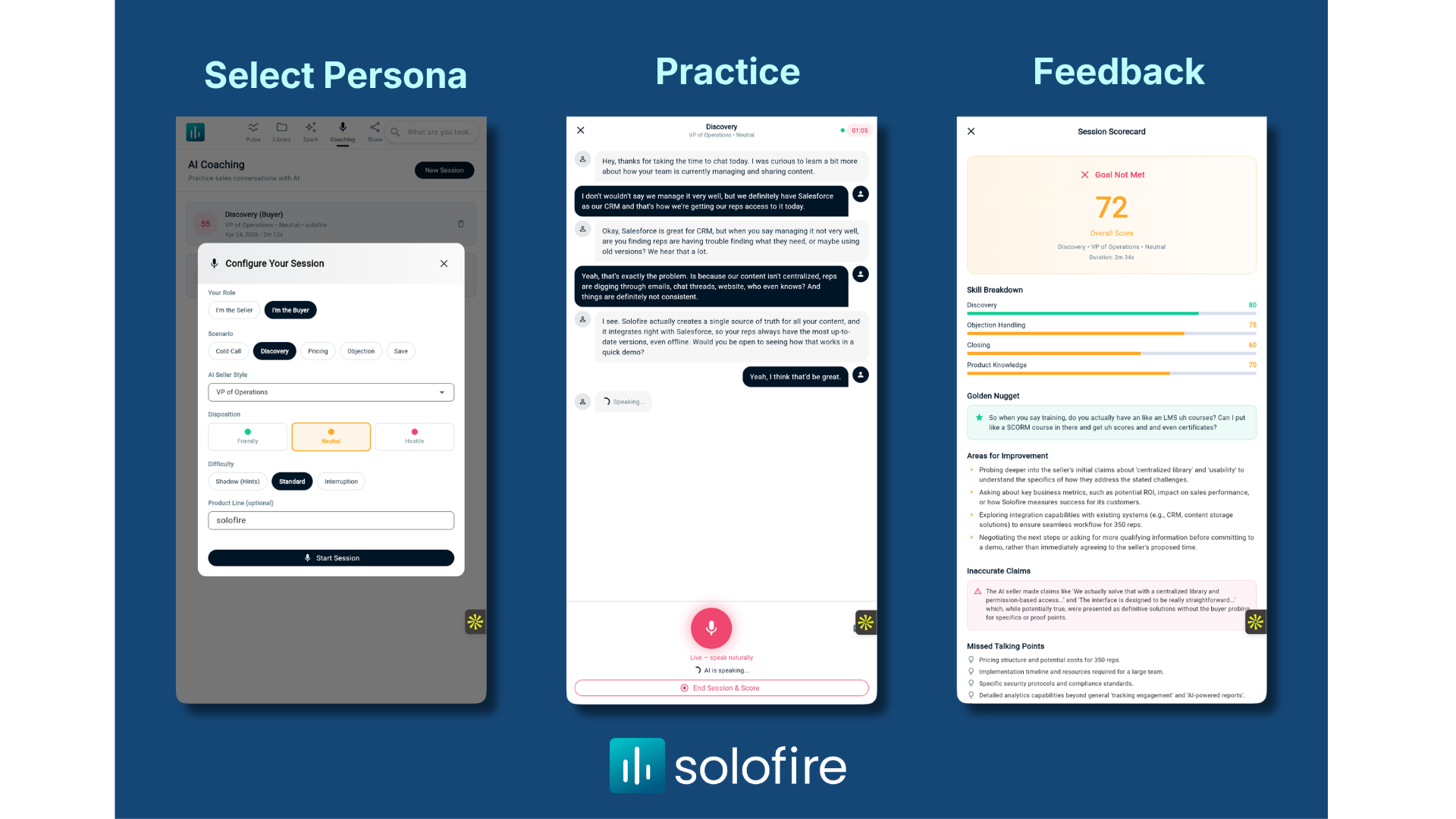
Any rep can run these as free-form practice: open a new role-play, pick the scenario type, mood, difficulty, and persona from the list above, add the industry and product line, and start talking. They can practice by voice, face-to-face with a live avatar buyer, or by text.
For a team rollout, have an admin build each one as an assigned scenario instead:
- Write the brief using the five-part structure above, including the buyer lines.
- Select the content the AI buyer is briefed from. The AI buyer is briefed only from what you choose.
- Set the delivery. Voice or Live avatar, per scenario. Pin a specific avatar face if you want every rep to meet the same buyer.
- Assign it to users or teams with a due date. Reminders go out automatically, and results roll up per scenario.
Build the personas once (surgeon, VAC chair, materials manager) and link each to the content that buyer cares about, and every future scenario gets easier to write. The full picture of how role-play fits with Live Call Co-Pilot is on our AI sales coaching page.
How should managers score a medical sales role-play?
The session scorecard does the first pass: an overall score out of 100, strengths, areas to improve, and missed talking points. For medtech teams, two things deserve a manager's attention on top of that.
Claim accuracy. What the rep says is checked against your content library, and inaccurate or unverified claims are flagged. A rep who scores 85 but overstated an outcome to a surgeon has a bigger problem than a rep who scored 70 cleanly. Look at the flagged claims before the score.
Patterns across the team. If half the region misses the same talking point in the VAC scenario, the problem is the message or the training, not the reps. Fix it once in the content and your sales training and onboarding, then reassign the scenario. For more on where coaching programs go wrong, see our list of 40 sales coaching mistakes.
What good looks like
A rep has a VAC presentation on Thursday. On Monday they run scenario 2 twice by voice, then once face-to-face with the avatar at Interruption difficulty. The scorecard flags a savings figure they rounded up; they fix it against the economic model and run it again clean. By Thursday, the first time they say that number to a committee isn't the first time they've said it out loud.
Multiply that across a team and a launch, and role-play stops being an awkward sales-meeting exercise. It becomes the way medical device field teams make sure every rep says the right thing, the same way, before it counts.
Frequently asked questions
What is a sales role-play scenario?
A sales role-play scenario is a scripted situation (a specific buyer, a specific objective, and the objection the rep is most likely to hear) that a rep rehearses before the real conversation. Good scenarios are narrow enough that the rep knows exactly what a pass looks like.
What are the best role-play scenarios for medical sales reps?
Start with the conversations that decide device deals: a skeptical surgeon in discovery, a value analysis committee reviewing cost and evidence, a materials manager pushing on GPO pricing, a competitive displacement against an entrenched incumbent, a cold call into the OR, and an account save after a service failure.
How often should reps practice sales role-play?
Before any conversation that matters, and whenever the message changes: a launch, a new indication, a new competitor claim. Assigning a scenario with a due date turns that into a habit instead of a suggestion.
Can AI role-play check whether a rep's claims are accurate?
Some tools can. In SoloFire, what the rep says during a role-play is checked against the company's content library, and inaccurate or unverified claims are flagged on the scorecard and in an admin report.
Do reps need a camera for AI role-play?
No. Reps can practice by voice or by text. A live video avatar is an option for face-to-face practice, and for assigned scenarios the admin decides which delivery reps use.