
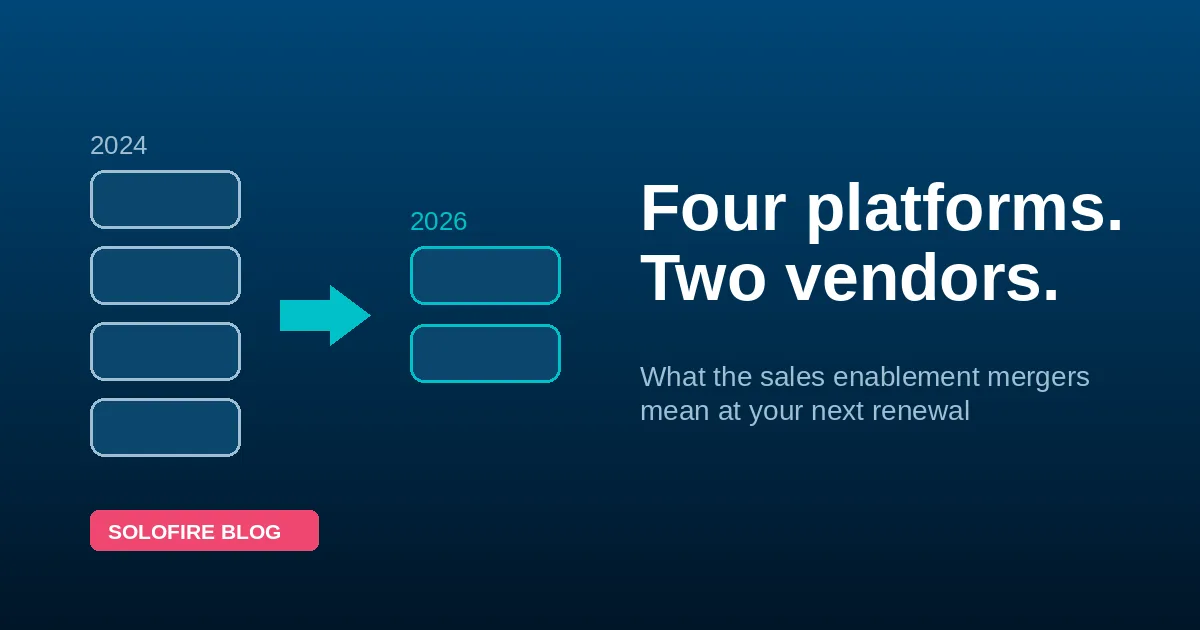
If your field team runs on Showpad, Bigtincan, Seismic, or Highspot, the company you signed with is not the company you will be renewing with. In the space of ten months, four of the largest sales enablement platforms became two.
That is not a reason to panic. It is a reason to pull out your contract, ask better questions, and make your next decision on your own timeline instead of your vendor's. Here is what actually happens after a sales enablement vendor merger, and what a medical device or life science team should do about it.
What happened, in plain terms
Two separate deals, both closed.
Showpad and Bigtincan. Vector Capital, which had already bought Bigtincan in April 2025, completed its acquisition of Showpad on October 30, 2025 and combined the two companies under the Showpad brand, with a new CEO and more than 2,000 customers across 50 countries. Bigtincan had previously absorbed Modus, so three former competitors now sit under one roof.
Seismic and Highspot. The two announced their intent to merge in February 2026 and completed the merger on August 18, 2026. The combined company operates as Seismic, claims 2,500 customers and 3.5 million users, and has said detailed roadmap plans will come at its user conference in mid October.
At announcement, both sides said both platforms would continue to be supported. Take them at their word. Then notice that "supported" and "invested in" are two different words, and that every merger announcement in software history has used the first one.
Why does a vendor merger matter to the customer?
Because two products that do the same job do not stay two products. Merging is expensive, and the way the acquirer earns that money back is by running one platform, one support organization, and one sales team instead of two. That is rational for the vendor. It is also a multi-year project that happens on your account, with your content, on their schedule.
For a med device or life science team the exposure is specific. Your reps work in hospitals where the app has to function without a signal. Your content passes through a review process before it can be shown to a clinician, and that approved state has to survive whatever migration is coming. Your distributors and 1099 reps are on the platform under access rules someone built carefully two years ago. None of that is guaranteed to carry over intact when a product line gets folded into another one.
The right move is not to bolt. It is to know exactly where you stand before your renewal date, which is why we keep a plain comparison of every major platform current, mergers included. Understand what is changing first. Then decide.
Six things that change after a merger
1. The roadmap gets redrawn
The features you were promised in last year's QBR were prioritized by a product team that may no longer exist in the same form. Post-merger roadmaps get rebuilt around the combined platform, and the items that survive are the ones that serve the largest accounts. If you are a 40-rep specialty device company, you are not the largest account.
2. One product line becomes the legacy product
Nobody announces this on day one. It shows up as fewer releases on one side, a slower support queue, and an account manager who starts describing the other platform as "where we are heading." If you are on the side that is not the survivor, the migration is a question of when, not if.
3. A migration lands on your calendar
Moving content, folder structures, user groups, permissions, analytics history, CRM integrations, and rep habits from one platform to another is a real project. It typically arrives as "good news" from the vendor, on a timeline that suits their consolidation plan, and it is rarely priced into the renewal you already signed.
4. Your support and success contacts change
Combined companies merge their customer success and support teams. The CSM who knew your compliance workflow gets a new book of business, or a new employer. Response times drift while two ticketing systems and two knowledge bases become one. We wrote about what happens when support quality slips and how quickly it sends customers shopping. Mergers are a common cause.
5. Pricing gets harmonized
Two price books become one. If you were on the cheaper one, expect the renewal conversation to include the phrase "aligning to our standard packaging." If you were on the pricier one, do not expect a call offering you the other list.
6. Contract terms get re-papered
New entity, new master agreement, new data processing terms. This is a legitimate moment to renegotiate, and most customers let it pass because the paperwork arrives labeled as routine.
What should you ask your vendor at renewal?
Send these in writing, before the renewal call, and ask for written answers. Vague responses are an answer too. One question worth adding to the list this year: whether the platform can connect your content library to AI assistants like ChatGPT and Claude — a capability gap that says a lot about a roadmap.
| Question | Why it matters |
|---|---|
| Which platform is the surviving product, and what is the published end-of-life date for the other one? | Tells you whether a migration is coming and how long you have. |
| Will my team be migrated? If so, when, who does the work, and who pays for it? | Migration labor is the hidden cost of a merger. Get it in the contract. |
| Which features that we use today are not in the surviving platform? | Feature parity gaps are where field workflows break. Ask for a list, not a reassurance. |
| What happens to our analytics and engagement history during migration? | Years of content performance data can disappear in a platform move. |
| Does offline access work the same way in the surviving product? | Non-negotiable for reps in hospitals and ORs. |
| How are distributor and external user licenses handled going forward? | Channel access rules and pricing are often the first things to change. |
| Who is my named support and success contact for the next twelve months? | If they cannot name a person, your account is in a queue. |
| Will our per-user price change at renewal, and what is the new price book? | "Harmonized pricing" usually moves in one direction. |
| Can we shorten the renewal term to twelve months while consolidation is in progress? | Flexibility is worth more than a multi-year discount right now. |
| What are our data export rights, and in what format? | You need a clean way out whether or not you use it. |
| Which integrations (CRM, SSO, LMS) are confirmed for the surviving platform? | Integrations are rebuilt, not copied, in a consolidation. |
| Can we get the above in writing as an addendum to the renewal? | If the answer is no, that is the most important answer you received. |
How to protect your team without switching, yet
You may decide the merged vendor is still the right fit. Even then, do these four things before you sign anything.
Export now. Pull a full copy of your content library, folder structure, user list, and whatever analytics you can get out. Do it while your current contacts still know how.
Document your workflows. Write down how content gets approved, published, segmented by team or distributor, and retired. This is the checklist you will hand to whoever runs the migration, or to a new vendor.
Shorten the term. A twelve-month renewal during a consolidation costs you a small discount and buys you the right to decide again next year with better information.
Run a parallel look. Sixty to ninety days before renewal, put two or three alternatives through a real evaluation with your own content, even if you expect to stay. It takes the leverage away from the "aligned pricing" conversation, and it costs an afternoon.
What is the best alternative to Seismic or Showpad for a mid-size field team?
If the answers you get back are thin, the evaluation stops being a formality. The honest answer to "what is the best alternative" is that it depends on the size and shape of the team; a 500-seat pharma sales force and a 40-rep specialty device company should not buy the same platform. A few criteria that matter more than usual right now for medical device sales enablement:
- Ownership and focus. Who owns the company, and is your industry the business or a segment of it? A vendor whose whole customer base looks like you does not consolidate you into someone else's roadmap.
- Published pricing. If the price is on the website, it is not going to be harmonized at renewal. Compare against a published per-user rate before you accept a private quote.
- Offline first, not offline supported. Ask to see the app with airplane mode on.
- Migration included. The vendor should move your content, not hand you a template.
- Contract overlap handled. If you are mid-term, look for a program that lets you switch without paying two vendors at once. Our version is called No Double Pay: you use SoloFire at no cost until your existing contract ends, with migration included.
Vendor-specific notes live on the comparison pages: Showpad alternatives, Bigtincan and Modus alternatives, Seismic alternatives, and Highspot alternatives. For the full field, the 2026 buyer's guide compares all eight major platforms on offline reliability, compliance, training, and price.
What good looks like
A commercial operations lead at a mid-size orthopedic company gets the merger email in August. Instead of filing it, she pulls the contract and finds the renewal is in February. She sends the twelve questions above the same week and gets written answers by October: the surviving platform is the other one, migration is "planned for 2027," offline behavior is "being evaluated," and pricing will "align to standard packaging."
She exports the library in November, runs two alternatives against it with three field reps in December, and walks into the renewal call in January with a real option in hand. Whatever she chooses, the vendor is now negotiating with her, not the other way around. That is the whole goal.
Start with the contract. Find the renewal date, count back ninety days, and put the twelve questions in an email today. If leaving is on the table, our guide to getting out of a sales enablement contract walks through the notice window step by step.