
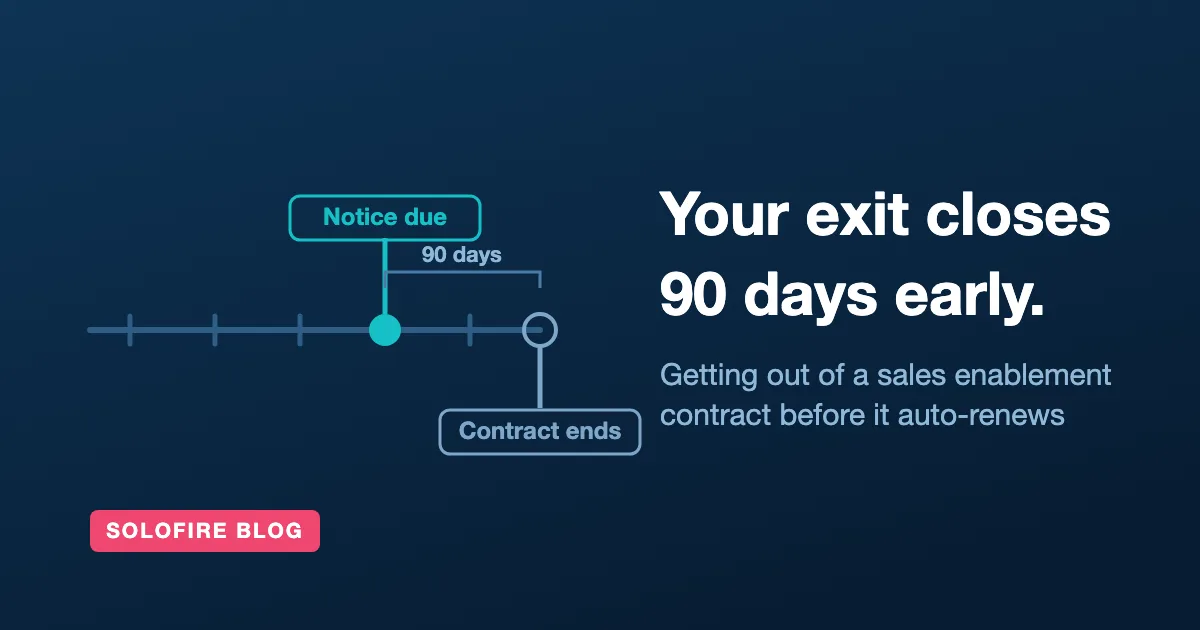
If you need to get out of a sales enablement contract, the clock matters more than the contract. Most enablement agreements renew themselves automatically, and the window to stop that closes 30 to 90 days before the end date printed on the agreement.
Miss the window and you are not negotiating an exit anymore. You are locked in for another term, and any platform move now means paying two vendors at the same time. This guide covers the mechanics: what the renewal clause actually says, how to find your real deadline, what to do if the deadline already passed, and how to time a switch so the budget never doubles up.
For a medical device or diagnostics sales team, a missed renewal window usually ends one of two ways. Either you stay another year on a platform your reps have stopped opening, or you buy the platform you actually want and pay for both until the old contract runs out. Finance rarely approves the second one, so the champion who pushed for a change spends another year defending a line item nobody likes.
It does not have to go that way. Start early enough and the sequence is boring: give notice on time, onboard the new platform during the overlap, and let the first invoice land when the old one ends. Closing that gap is exactly what SoloFire's switch without paying twice program exists for, and the earlier you start, the more of the overlap it covers.
Why teams are reading their enablement contracts right now
The enablement market consolidated fast. Seismic completed its merger with Highspot in August 2026, and Vector Capital closed its acquisition of Showpad in late 2025 after buying Bigtincan earlier that year. Four platforms became two owners in about a year, and both owners now face 12 to 24 months of product integration.
The complaints that push teams to start shopping are rarely dramatic. They are operational: PowerPoint uploads that quietly drop slides and animations, analytics the team stopped trusting, forced downloads of large files in hospitals with bad connectivity, and support tickets that used to take a day and now take a week. Bad support sends customers shopping, and a merger integration is when support quality slips first.
If your platform is one of the four, the twelve questions to ask your account manager are in our guide to when your enablement vendor merges. The renewal is the one moment you have real leverage with a consolidating vendor, which is exactly why the notice window deserves more attention than it gets.
What does the renewal clause in your contract actually say?
Auto-renewal is the default in this category, not the exception. In Common Paper's analysis of its standard customer agreements, 85% of SaaS contracts renew automatically, 84% of those set a 30 day non-renewal notice period, and 21% include an automatic fee increase at renewal, most commonly 5 to 8%. Negotiated enterprise deals, which is what most enablement contracts are, tend to carry longer windows: 60 and 90 days are common.
The clause usually pins down four things. Find all four in your agreement:
- The renewal term. Usually the same length as the original term. A three year deal can renew for three more years, not one.
- The notice window. How far before the end date your written notice must arrive. Not be sent. Arrive.
- The delivery method. Some contracts accept email. Others require written notice to a specific address, sometimes by certified mail. Notice sent the wrong way can be treated as no notice at all.
- The renewal price. Capped, tied to an index, or silent. Silent usually means uncapped in practice, and that automatic 5 to 8% increase is where it hides.
Pull the agreement and find these four items today, even if renewal feels far away. Ten minutes now decides how much leverage you have later.
When is your real deadline?
Your real deadline is not the contract end date. It is the last day the vendor can receive your non-renewal notice, and it lands 30 to 90 days earlier. A contract ending March 31 with a 90 day window has a real deadline of December 31. Teams plan their evaluations against spring and lose the decision in December without noticing.
One more point worth knowing: sending non-renewal notice does not force you to leave. It stops the automatic renewal. You can still renew afterwards, usually on terms you negotiated rather than terms that renewed themselves. Sending notice on time keeps the choice yours.
Here is the timeline that keeps the exit orderly, working back from the contract end date:
| Milestone | What to do |
|---|---|
| 120 days out | Pull the contract. Confirm the end date, notice window, renewal term, and required delivery method. Put the notice deadline on the team calendar with two reminders ahead of it. |
| 100 days out | Decide: renew, renegotiate, or leave. If it is either of the last two, start evaluating alternatives now. The factors that matter for regulated field teams are in our guide to choosing a sales enablement app. |
| Before the notice deadline | Send written non-renewal notice exactly the way the contract specifies, and keep proof of delivery. If the contract says certified mail, send certified mail. |
| 60 days out | Inventory what you own: export content, SCORM packages, usage data, and user lists while the relationship is still cooperative. |
| 45 days out | Sign with the new vendor and onboard while the old contract runs out, so reps switch platforms once, not twice. |
| Contract end | Old access ends. The new platform is already live, and its first invoice starts here, not months earlier. |
What if you already missed the notice window?
It happens constantly, and the honest answer is that your legal position is weak. Courts generally hold commercial parties to the deadlines they signed, and business buyers do not get the protections that apply to consumer subscriptions. Vendr's guidance on missed cancellation windows is a good summary of the practical options. In short:
- Call the vendor before the renewal invoices. Ask for a shorter renewal term, a month to month bridge, or a reduced seat count. Vendors facing churn at the next renewal often prefer a smaller contract to a resentful customer.
- Check your state's law. A few states extend auto-renewal rules to business contracts. New York's General Obligations Law 5-903 and Wisconsin Statute 134.49 can make a renewal unenforceable if the vendor never sent the required reminder, and Colorado extended its rules to business subscriptions in February 2026. Bind Legal keeps a useful overview of the state rules. Ask your counsel whether one applies; this is a prompt to ask the question, not legal advice.
- Send notice anyway, for the next window. If you are stuck for another term, send compliant non-renewal notice now so the same clause cannot catch you twice.
- Use the year. A locked-in term is also twelve months to run a proper evaluation, clean up your content library, and line up a switch for the day the term actually ends.
How do you switch platforms without paying twice?
The reason most switches stall has nothing to do with product fit. It is that the champion has to ask Finance for money that is not in the budget, for a category the company is already paying for. Nobody wants to sponsor a double payment.
The structure that removes the problem is overlap coverage: sign with the new vendor now, onboard now, and pay nothing until the current contract ends. SoloFire runs this as a standing program. Use the platform free for up to six months of overlap, migration and onboarding included, with the first invoice landing the month your current contract expires, in exchange for a 24 or 36 month term. Because what SoloFire costs is a single all-inclusive rate, the champion can hand Finance one number and a start date instead of a spreadsheet of tiers and add-ons.
The overlap is also the one deadline in this whole process that is arithmetic rather than sales pressure. The free window covers the months between signing and your old end date, so it shrinks every month you wait. Starting at 100 days out is simply worth more than starting at 30.
What a clean exit looks like
A team on a consolidating platform pulls its contract in the fall and finds a 90 day notice window against a March 31 end date. The deadline goes on the calendar for December, with reminders in October and November. They compare platforms through October, send certified notice in early December, and sign with the winner in January.
Reps onboard in February while the old platform winds down. Content, SCORM courses, and user groups move over during the overlap. On April 1 the old access ends, the new platform has already been running for two months, and the first invoice arrives against a budget line that never doubled. Nobody in Finance remembers the switch, which is the point.
The next step takes ten minutes: pull the contract, find the notice window, and put the real deadline on the calendar. Every other decision follows from that date.