
Buyer enablement is the work a seller does to help the customer's buying group reach a decision and defend it. That means giving the buyers the information, tools and structure they need for the parts of the purchase that happen without the rep. In medical device sales, that is most of the purchase.
The surgeon who loved the demo doesn't sign the purchase order. A value analysis committee, a supply chain director, a biomed engineer and, for capital equipment, a finance committee each decide whether the deal moves. Most of them decide in meetings you won't attend, often months after your last visit. What they have in front of them when they decide is what you sent. This post covers what to send, how to keep it working across a long cycle, and what to do once you can see what happens after you hit send.
What is buyer enablement?
Sales enablement equips the seller. Buyer enablement equips the buyer. The two overlap, but they answer different questions. Sales enablement asks, "Can my rep explain this product?" Buyer enablement asks, "Can the people on the customer's side explain it to each other without my rep in the room?"
Gartner's research on B2B purchasing shaped the idea. Its finding is counterintuitive: the problem is rarely a lack of information. In a Gartner survey of more than 1,000 B2B customers, 89% said the information they found during the purchase was high quality. Yet buyers who were overwhelmed by too much, or contradictory, high-quality information were 153% more likely to settle for a smaller, less disruptive purchase than they had planned.
So buyer enablement isn't about sending more. Gartner calls the approach that works "sense making": helping buyers weigh sources, quantify trade-offs and reconcile conflicting information. It found that 80% of sellers who used it closed high-quality, low-regret deals.
Why do long medical device sales cycles need buyer enablement?
Because the buying group is large, it changes over time, and it rarely meets you all at once.
Gartner's 2025 buying-group research put B2B buying groups at five to 16 people across as many as four functions, and found that 74% of buyer teams show "unhealthy conflict" during the decision. The more useful finding is about content. Content tailored to what the group needs made buyers three times more likely to report a high-quality deal. Content tailored to individual stakeholders had a negative effect on group consensus.
That describes a hospital deal exactly. If you send the surgeon a surgeon deck, the CFO a cost deck and supply chain a contract sheet, each built separately in separate email threads, you have given the committee three versions of your story to argue about. Buyer enablement means one shared, current source that each stakeholder can find their part of. That is the job of trackable content sharing: one branded page per account that everyone can open without a login, that stays current, and that shows you who actually engaged.
If the committee is the stage you are preparing for, the value analysis committee field guide covers the submission itself. This post is about the months around it.
What does each stakeholder need between meetings?
Use this map to plan what goes on the page, and what engagement to watch for from each role.
| Stakeholder | What they must justify internally | What to put in front of them | Signal worth noticing |
|---|---|---|---|
| Clinical champion | Why this is worth the committee's time | The two or three studies that matter, a one-page evidence summary, a technique video | Forwards the page; new viewers appear |
| Value analysis committee | Clinical, operational and financial impact | Evidence summary, comparison with the incumbent, trial protocol | Several new viewers in the week before the submission deadline |
| Supply chain / procurement | Contract fit and total cost | GPO and contract status, pricing rationale, cost model | Time spent in the cost model |
| Biomed / clinical engineering | Service, integration and maintenance burden | Service plan, specs, installation requirements | Views of technical documents late in the cycle, usually a sign the deal is real |
| Infection prevention | Reprocessing and cleaning risk | Cleaning and reprocessing instructions, validation summaries | Any view at all: this group seldom looks unless the device is under active evaluation |
| Nursing / OR education | Training load on staff | In-service plan, training videos, go-live timeline | Repeat views of training material |
| CFO / capital committee | Return on the capital, and why it should be funded this budget cycle | Budget-ready summary, an ROI calculator the buyer can run with their own numbers | A finance-domain viewer who comes back more than once |
Keep the page short enough to read on a phone between cases. Mobile is how clinical stakeholders will see it. A page is an argument, not an archive. If a piece doesn't help someone on this list justify a decision, cut it.
What happens after you hit send?
With an email attachment, nothing you can see. With a tracked page, you get a stream of small signals. Reading them well is most of the skill.
- Opened the same day, then silence. Your champion is interested but hasn't advanced it. Offer to make their internal job easier. A shorter summary they can present often works better than another follow-up.
- New viewers you have never met. The page is being forwarded, and the buying group is forming. Find out who they are before the committee meeting, not after.
- Heavy time on one document. Someone is working on a specific question. A long stay on the cost model before a budget meeting means your next call should be about money, not features.
- A revisit weeks later. Long cycles go quiet and then restart. When a dormant page comes back to life, it often means the budget cycle, a contract renewal or a committee date is approaching.
- Only ever one viewer. A single-threaded deal. If nobody beyond the champion has opened anything by the time a committee date is set, that is a risk to raise, not a detail to hope through.
One rule of tact: act on the signal, but don't narrate it. "I added a one-page cost summary your finance team can use" lands better than "I saw someone spent eleven minutes on page four." For more on reading contact-level history, see how a contact timeline changes follow-up. For the mechanics of the page itself, see what a digital sales room is.
How do you keep buyers enabled across a nine-month cycle?
Keep one living page per account. Across a long cycle, an email thread breaks into forwards, reply-alls and outdated attachments. A single link that you update keeps every stakeholder on the same version of the story, which is exactly the consistency Gartner links to better deals. Gartner reports that buyers who encounter consistent information across supplier sources are 2.89 times more likely to complete a high-quality, low-regret deal.
Change it as the deal moves through stages. Early on, the page is clinical. Near the committee date, it is economic. After approval, it covers implementation and training. Swap sections as the questions change, and use only approved, current versions. A study that marketing retired in March shouldn't still be on the page in June.
Make engagement visible to the rest of the team. Reps change territories and managers review pipeline, so engagement data that lives only in the rep's inbox disappears with them. Shares and views should log automatically to the account through automatic CRM logging, so whoever picks up the account next can see who read what.
Plan for the budget cycle. Capital deals often slip to the next fiscal year. Put a note in the account to refresh the page about 60 days before the hospital's budget planning starts, with anything that changed: new evidence, new contract terms, a new reference site.
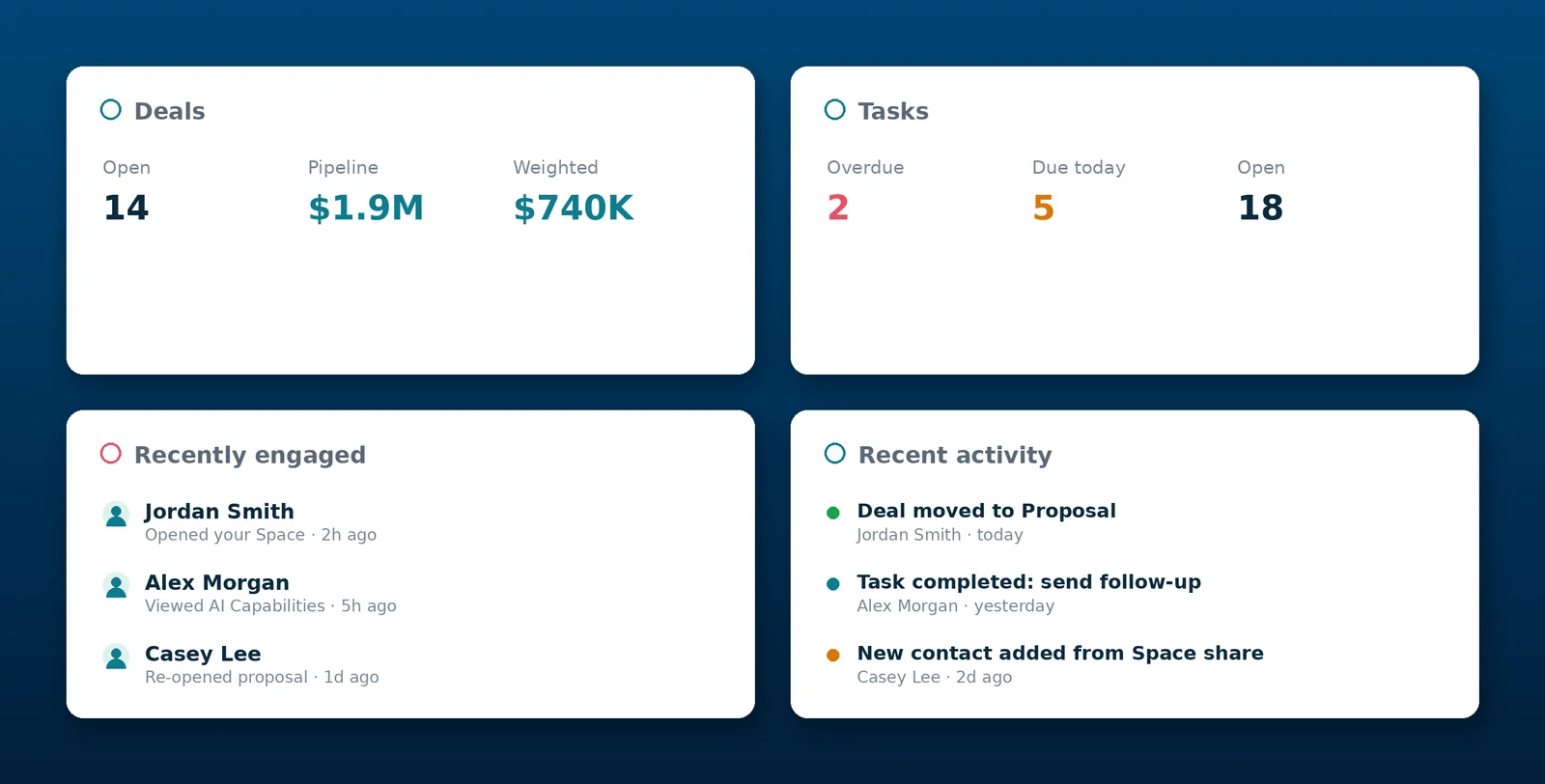
In SoloFire, this is how Spaces work. A rep builds a branded, no-login page from the approved library in the app. Each file view is tracked by person and duration, the rep gets an engagement summary within about 15 minutes of a visit, and activity logs to Salesforce, HubSpot or Dynamics 365 without data entry.
What good looks like
A rep selling a capital system gets a positive first evaluation in February. That afternoon she sends her surgeon champion a single page with two studies, a technique video and a one-page evidence summary.
In March, three new viewers appear, one of them from biomed, reading the service plan. She adds installation specs and a line about loaner coverage during installation. The page goes quiet in April. In May it comes back: the champion and someone from supply chain are both in the cost model. She calls about pricing structure, not "checking in," and adds a budget-ready summary for the capital committee. When the committee meets in June, every member has read the same current version of the story, and she knows which of them read it.
None of that took more content. It took one current page and the discipline to read what happened after she sent it. Teams that want to see this at scale can read the case studies. Otherwise, the test is simple: pick your longest open deal and count how many of its stakeholders have seen anything you sent. Whatever that number is, raising it is your buyer enablement plan.
Frequently Asked Questions
What is the difference between buyer enablement and sales enablement?
Sales enablement equips your reps with training, content and tools. Buyer enablement equips the customer's buying group to understand, compare and justify the purchase, especially when the rep isn't present. Good programs do both, and the same approved content library should feed both.
Is buyer enablement the same as a digital sales room?
No. Buyer enablement is the strategy, and a digital sales room is one of its most useful tools: a single branded page per account that holds current content and shows engagement. You can do buyer enablement without one, but it is much harder to keep a long cycle consistent.
What counts as buyer enablement content in medical device sales?
Anything a stakeholder uses to justify the decision internally: evidence summaries, cost models and ROI calculators, contract and GPO status, service and installation plans, reprocessing instructions, and in-service training plans. Brochures written for a single audience are usually less useful than material the whole committee can share.
How do you use engagement tracking without seeming intrusive?
Act on the signal rather than describing it. If someone spent time on the cost model, send a clearer cost summary instead of mentioning what you saw. Tracking should make your follow-up more useful to the buyer, not show them how closely you are watching.